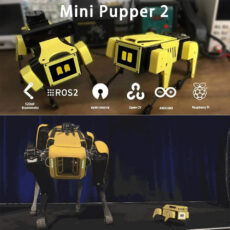

Photo credit: Zinj Guo
Computer scientists from the University of Massachusetts Amherst are currently developing functional robot guide dogs and training them required gathering 23 visually impaired dog-guide handlers as well as five trainers.
Through these observations, the team discovered that handlers do not use their dog as a global navigation system, but rather to control the overall route while the canine is responsible for local obstacle avoidance. Around 90% of the people in this group said that the most important feature of a robot guide dog would be at least a two-hour battery life for commuting.

- Build your own awesome, wearable mechanical hand that you operate with your own fingers.
- No motors, no batteries — just the power of air pressure, water, and your own hands!
- Hydraulic pistons enable the mechanical fingers to open and close and grip objects with enough force to lift them. Every finger joint can be adjusted...

We’re not the first ones to develop guide-dog robots. There are 40 years of study there, and none of these robots are actually used by end users. We tried to tackle that problem first so that, before we develop the technology, we understand how they use the animal guide dog and what technology they are waiting for,” said Donghyun Kim, assistant professor in the UMass Amherst Manning College of Information and Computer Science (CICS).