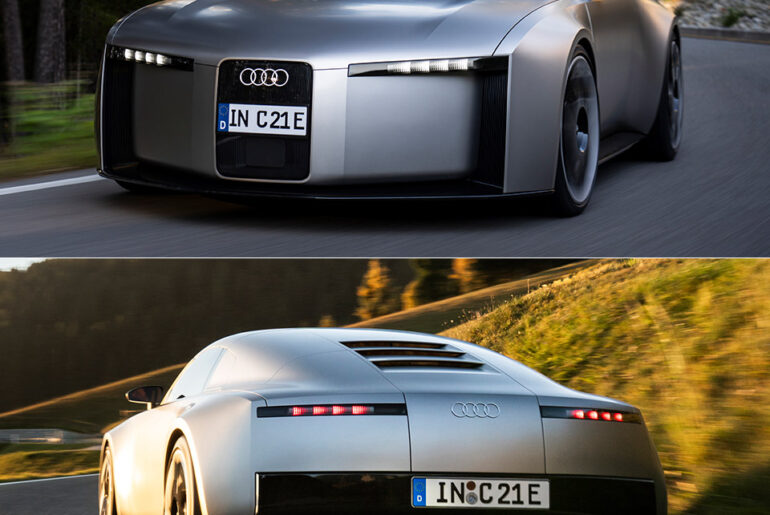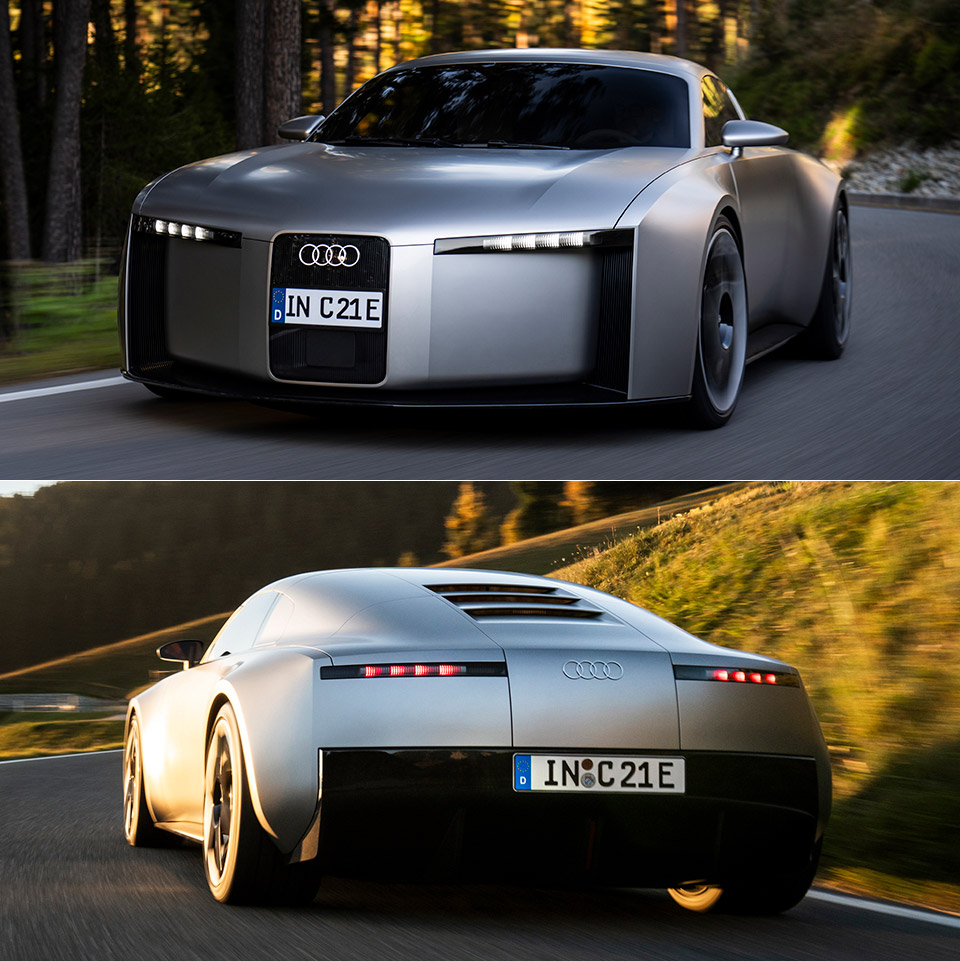
Audi unveiled the Concept C just over a month ago at the IAA Mobility Show in Munich and the two-seater stole the show with its sleek lines and poised stance. Engineers didn’t stop at the reveal – they put the prototype through a full testing program to make it roadworthy with German plates so it could hit the public roads. As the first real look at Audi’s next electric sports car due in 2027, the Concept C hints at a future where battery power delivers the thrill of a classic roadster.

Ferrari’s F40 is a sacred automobile in automotive history, as it was born in 1987 to commemorate the company’s 40th anniversary, and was the final project approved off by Enzo Ferrari himself. Its twin-turbo V8, carbon-Kevlar body, and lack of driving assistance enabled it to become the first road car to reach 200 mph.
![]()
Mercedes has always produced vehicles that turn heads, and the Vision Iconic does just that. This two-door coupe concept made its debut at Fashion Week in Shanghai, and its designers returned to the brand’s 100-year playbook to remodel the upright grille as well as three-pointed star into something that pays homage to the 1930s while looking forward.

Lamborghini revealed the Manifesto concept to commemorate the 20th anniversary of its in-house design studio, Centro Stile. Design director Mitja Borkert refers to it as a visionary sculpture that demonstrates the direction of the company’s design.

Dacia debuted the Hipster last week, a small electric vehicle with four seats and a foldable trunk in a box less than ten feet long. The Romanian company, famed for its no-frills vehicles such as the Spring, has expanded on this idea with its latest prototype. Engineers began with daily commutes in mind – short excursions around town or to the suburbs, nothing more – and everything follows from there. The Hipster is slightly under 3 meters long, 1.55 meters wide, and 1.53 meters tall, making it ideal for parking in compact areas.

Google Japan loves to surprise us with new keyboard concepts, and the Gboard Dial Version might be the most bizarre yet. This thing was inspired by old rotary phones and replaces the familiar click of keys with a smooth spin of dials.

Opel’s latest Grandland prototype is an autonomous SUV developed in collaboration with TU Darmstadt University that features a lighting system that signals to pedestrians. Colors and symbols replace traditional white LEDs and give us a glimpse into a future where cars don’t just drive on the road but engage with the people around them.

Now that the iPhone Air is out, rumors suggest Apple’s foldable phone, which has been in the works for years, will be very similar to its smaller sibling. Two of those Airs are said to be hinged together to form a book-style folder that unfolds into a device more like a tablet than a phone.

Photo credit: Ugur Sahin Design
Automotive designer Ugur Sahin has a habit of drawing cars that Porsche executives wish they had thought of sooner. From his workshop in the Netherlands, this digital artist turns idle what-ifs into sparkling visions, and his latest creation, the Porsche 960 GT RS, is not an official idea, but a secret challenge.

Lamborghini introduced the Pregunta in 1998, a one-off concept that was the result of unbridled imagination and engineering with no compromise. Built on the Diablo chassis, this car combines Italian style with French refinement, a fighter jet and enough power to get your heart racing.