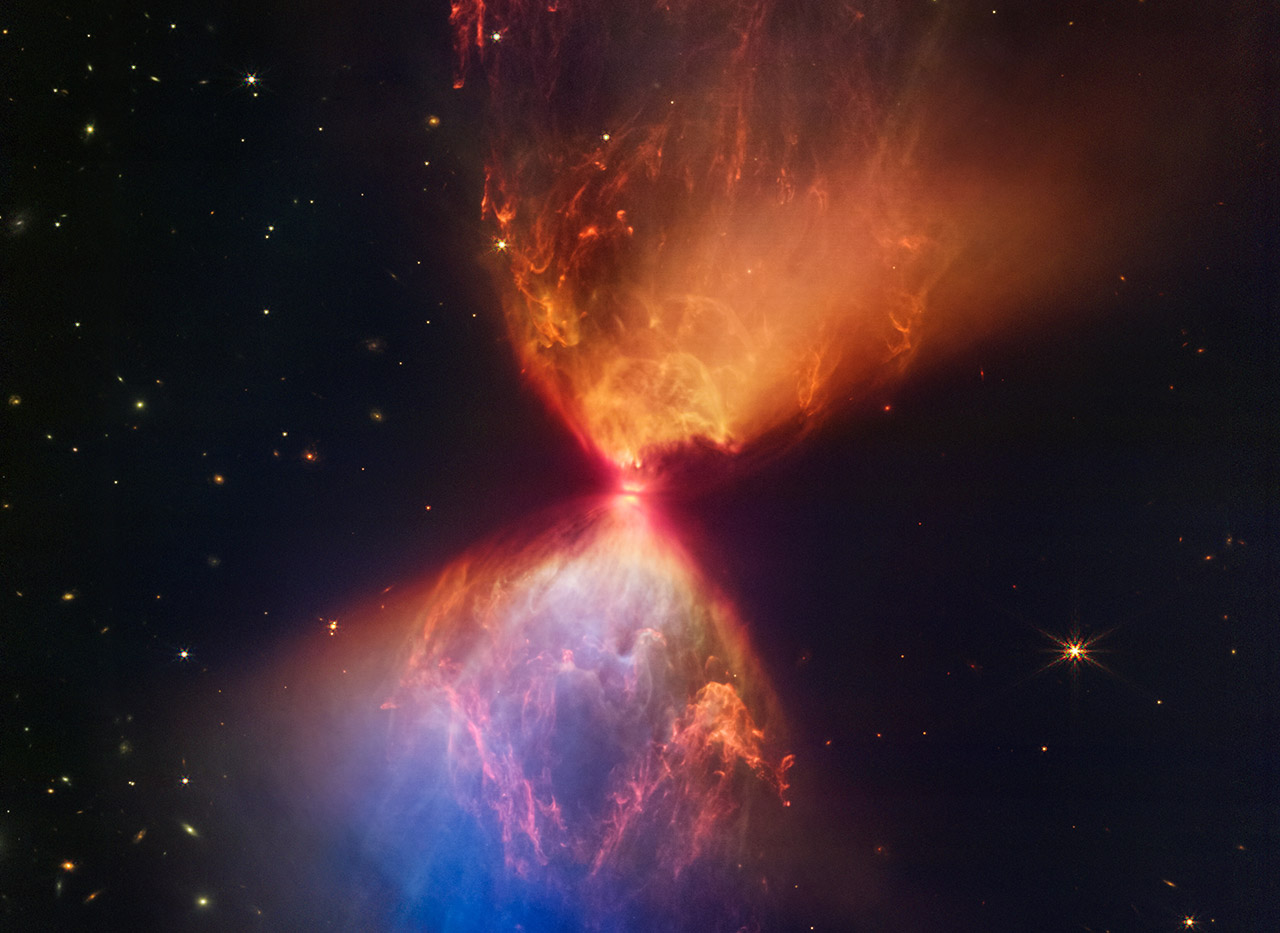

NASA’s James Webb Space Telescope continues to uncover the secrets of the universe, and its latest image is of Protostar L1527, a 100,000-year-old celestial hourglass. It was captured with its Near Infrared Camera (NIRCam), as the fiery clouds within the Taurus star-forming region can only be seen in infrared light, making it a perfect target for the space telescope.
What stands out the most in L1527 are the blue and orange clouds, which outline cavities created as material shoots away from the protostar. The colors are essentially layers of dust between Webb and the clouds, with blue areas being where the dust is thinnest. The thicker the layer of dust is where less blue light is able to escape, resulting in pockets of orange.

- COMPUTERIZED STAR LOCATING TELESCOPE: The Celestron NexStar 130SLT is a computerized telescope that offers a database of more than 4,000 stars,...
- COMPACT AND PORTABLE: This telescope for adults and kids to be used together is ideal for weekend camping trips or excursions to dark sky sites. Its...
- NEWTONIAN REFLECTOR OPTICAL DESIGN: The NexStar 130SLT is the largest in the SLT family. The 130mm aperture gathers enough light to see our Solar...
The disc, seen in the image as a dark band in front of the bright centre, is about the size of our Solar System. Given the density, it’s not unusual for much of this material to clump together — the beginnings of planets. Ultimately, this view of L1527 provides a window onto what our Sun and Solar System looked like in their infancy,” said the ESA.