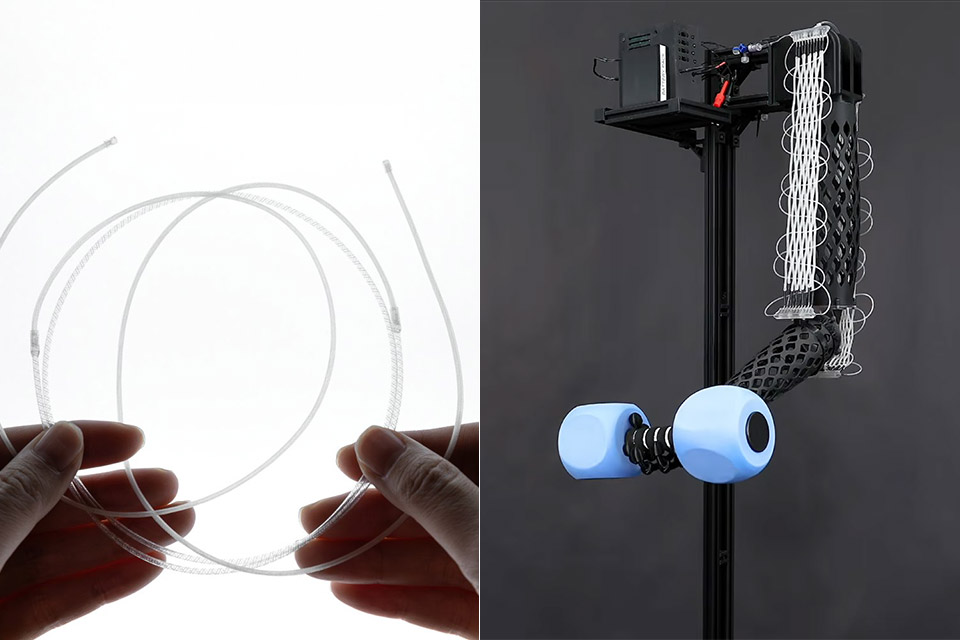
A pair of soft white tubes no thicker than a couple of strands of spaghetti rest in a researcher’s hands. They look almost fragile, yet these fibers can pull with the strength of real muscle, stay completely silent while they work, and run for hours on nothing more than a small battery pack. Researchers at the MIT Media Lab and Politecnico di Bari just published the full details of this system in Science Robotics, and the results feel like a genuine step change for anyone building humanoid robots or wearable machines.
Most robots are still powered by electric motors and gearboxes that simply spin a shaft and then convert that rotation into linear motion in the old-fashioned way, which works fine but has some significant drawbacks: it makes a racket, weighs a ton near the joints, and interferes with how our own limbs function. For years, soft fluidic actuators have been touted as a superior solution: long, flexible tubes that contract when pressed, similar to the muscles in your arm. The issue is with the massive pumps, compressors, and hoses that keep those actuators operating. They simply stop any possibility of a clean, portable design in its tracks.

- Three models, one lightweight platform R1 Air (20 DOF, monocular camera), R1 (26 DOF, binocular camera, head+waist joints), and R1 Edu (26 DOF...
- Easy setup – no coding required for basic use Unbox, power on, and start. Manual teaching feature: physically pose the robot, and it replays the...
- More DOF = more expressive movement 26‑DOF models (R1 / R1 Edu) add head and waist articulation for smoother dance and running. For safety reasons...
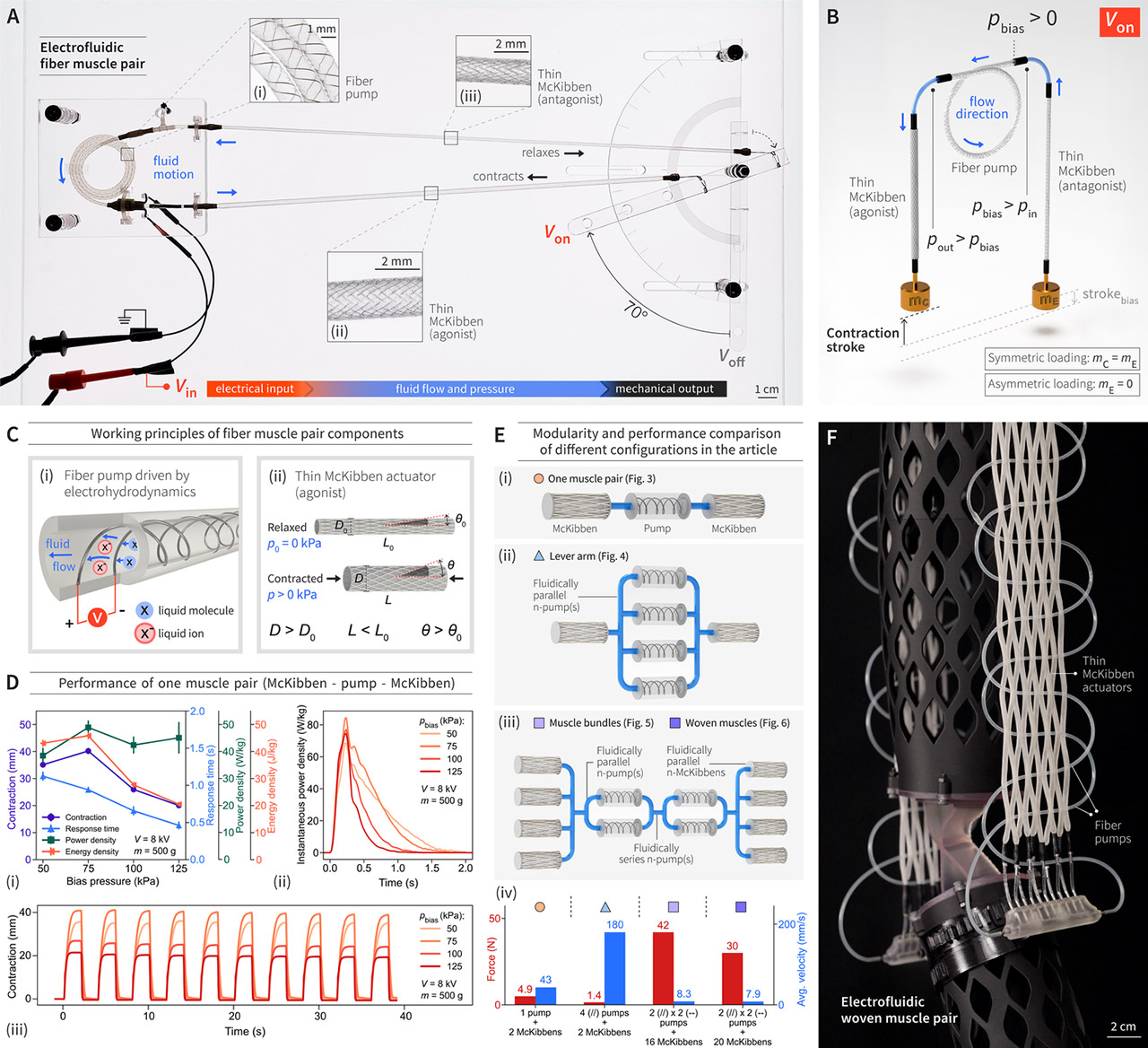
The new electrofluidic fiber muscles solve that problem by actually inserting the pump inside the muscle. Each pump is a tiny tube that is less than 2 millimeters wide. Inside, two thin helical electrodes weave their way along the length, and when exposed to high voltage, they begin to inject charge into a unique insulating liquid known as a dielectric fluid. The charged particles just drag the entire fluid along with them, generating pressure and flow with no moving parts. The entire system is absolutely silent and converts electricity directly into hydraulic power.
These tiny pumps form a closed loop with some thin McKibben-style actuators, which are essentially soft tubes wrapped in a braided sleeve that contract when the fluid inside them expands. You may simply stack one pump between two opposing actuators, exactly like your biceps and triceps operate together. When the pump pushes fluid into one actuator, that side shortens while the other side lengthens. There is no need for an external reservoir, therefore the entire system remains sealed, lightweight, and self-contained.
The performance stats are impressive, with roughly 50 watts per kilogram of power density and fibers that can contract by 20% of their length. When multiple pumps are operated in simultaneously, response times drop to less than 0.3 seconds. They also have a pre-pressure system that keeps everything stable and doubles the stroke three times for the same pump effort, and with the bias pressure, they can exchange a little maximal force for even faster snaps when speed is more critical than sheer power.
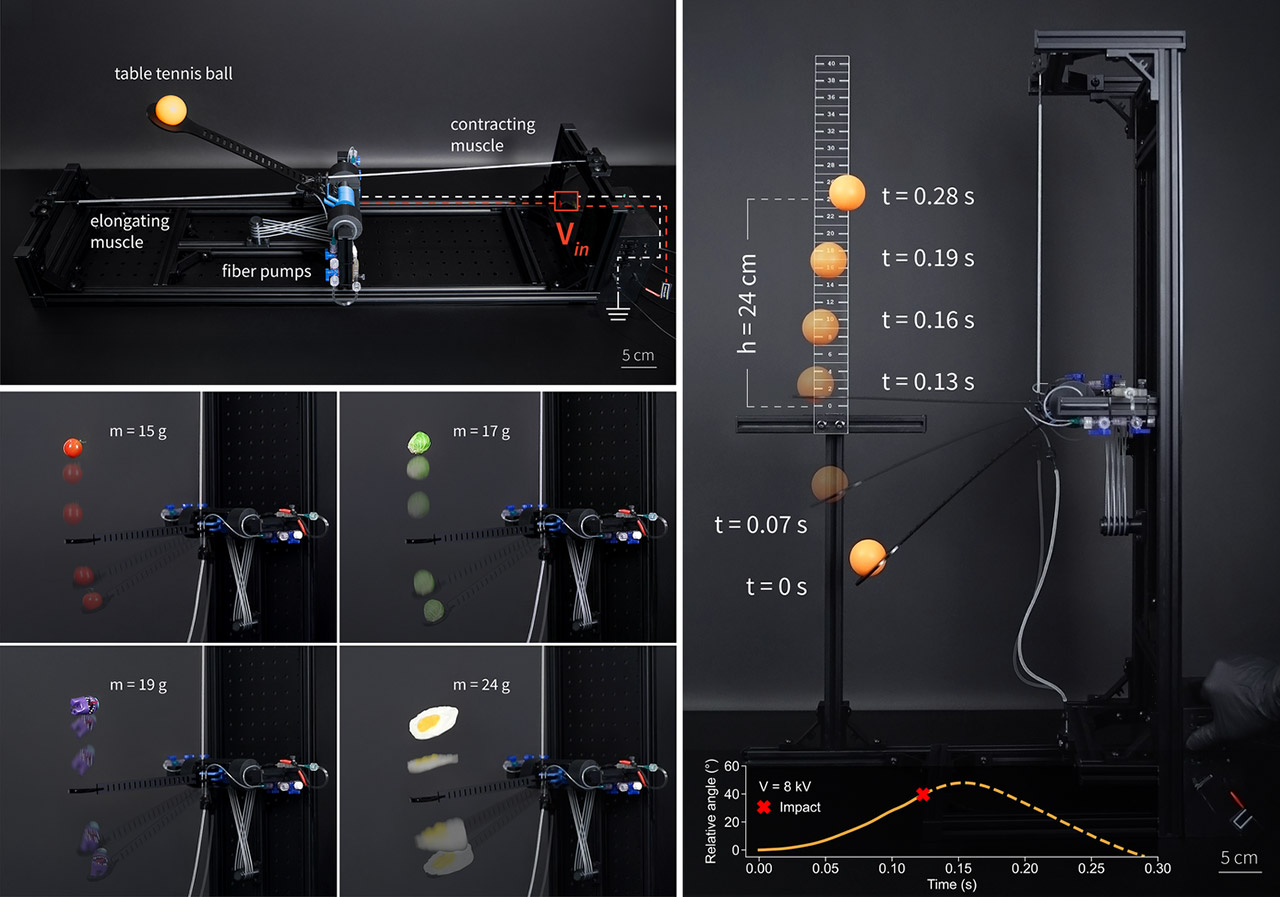
To demonstrate how adaptable the design is, the team demonstrated no fewer than three different setups. One of them launches table tennis balls in less than 2 tenths of a second, which is very quick. Another bundles a bunch of fibers together so that a small package weighing only a few dozen grams can lift four kilograms, or 200 times its own weight, with a beautiful clean 30-millimeter stroke. The most friendly-looking demonstration incorporated the fibers into a flat biceps-triceps pair that bends a 3D-printed robot arm in a full 40-degree arc. That same knitted muscle is supple enough to shake someone’s hand without squishing their fingers or feeling stiff.
[Source]