
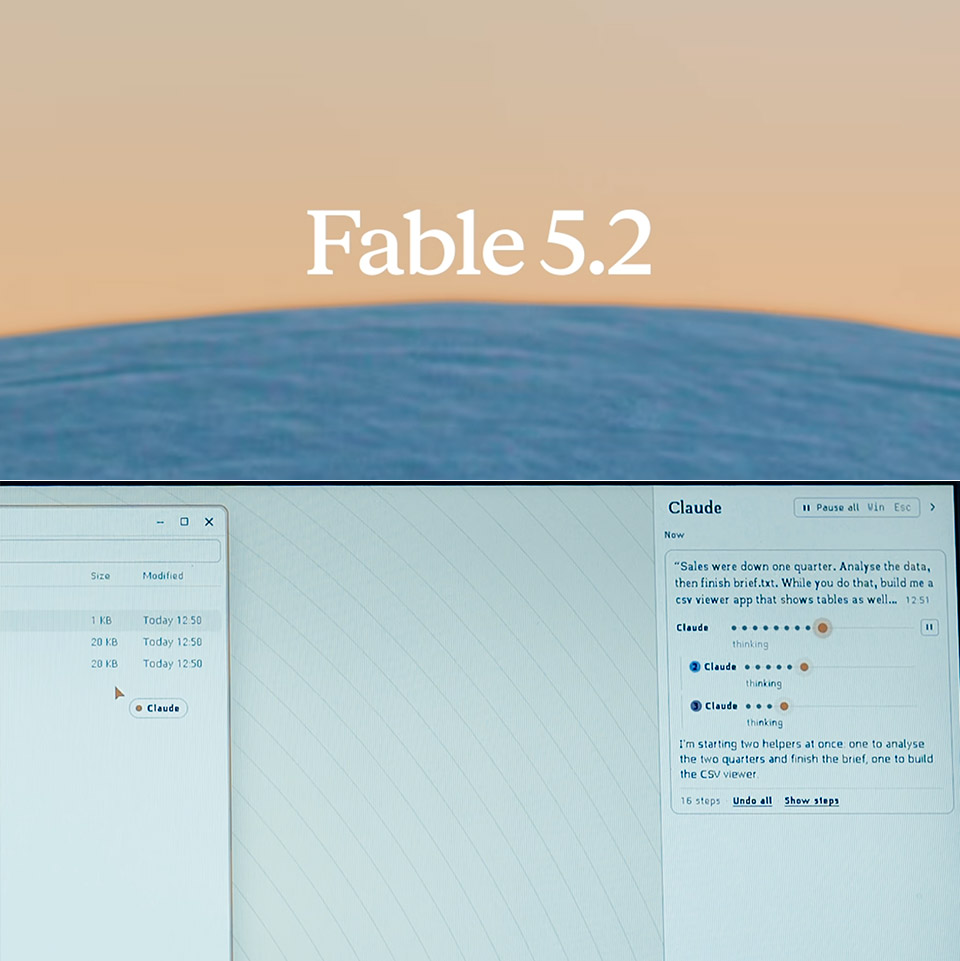
Anthropic released Claude Fable 5.2 today, the most recent version of its model designed for rigorous technical tasks. Regular users benefit from faster responses, clearer writing, and a price reduction that reduces the cost down to $8 per million input tokens and $40 per million output tokens. An optional fast mode doubles those rates in exchange for generating speeds that are two and a half times faster than the usual setting.
Compared to the previous version, everyday outputs now arrive up to 30% faster, yet the model still processes text and pictures, including PDFs, inside a one-million-token context window that allows for long sessions without constant restarting. Coding tasks are where the major gains are seen. Engineers evaluating the model completed things that previous versions could never even try in a reasonable time frame. They completed a production service migration from Python to Rust, which is now around 26 times faster. It has also enabled big numbers of sub-agents to collaborate on multi-repo projects while assessing and revising their own work.

- Capture every conversation clearly: Four microphones capture voices from up to 5 meters (16.4 feet) away. Note Pro detects in-person conversations and...
- Award-winning design: Winner of the iF, Red Dot Design, and the 2026 Good Design Awards. Just 2.99 mm (0.12 inches) thin and 30 g (1.06 oz), with a...
- Everything Included: Includes Plaud Note Pro, magnetic case, magnetic ring, charging cable, and a free Starter Plan with 300 transcription minutes per...
They demonstrated how a thousand of these agents could create an entire operating system in eight days from a simple prompt and an empty folder. It’s an impressive collection of components, including a kernel, drivers, storage, a graphical interface, and even an installer, all of which run on common hardware. They also transformed the entire formal proof of Fermat’s Last Theorem into computer-verifiable form in thirty hours. This produced a version that was seven times shorter than the last attempt, which took eleven days.
Its impact on the hardware and science fields is equally impressive. The model constructed three functional gadgets using a single paragraph of instructions: a home voice assistant, a USB speakerphone, and a handheld virtual pet. It sourced the necessary components from U.S. distributors, manufactured circuit boards, built 3D-printed cases, and created the software to assure that each unit worked without requiring future repairs.
In physics, they solved two problems that the community had been stuck on concerning black holes, and in robotics benchmarks, where the task is to control a simulated two-arm robot from a camera image, they more than doubled their success rate compared to the previous Fable release, outperforming other models on tasks such as solving a 3D cube or opening a bottle cap.
Everyday chat benefits from the same underlying improvements. The responses are significantly clearer than in previous Fable versions, and the model is sophisticated enough to determine how much mental effort a request requires. Users can still adjust the effort level between five levels for more control over speed and cost.
Anthropic has also stated that most typical coding and knowledge work can begin with the lower-cost Opus 5.5 model, then switch to Fable 5.2 when things get tough or extremely demanding. The model is now available through the Claude apps, Claude Code, the API, and the majority of the major cloud platforms (AWS, Google Cloud, Microsoft Azure, etc.), with Mythos 5.2 providing the same core functionality but only to organizations that first pass Anthropic’s verification tests for things like cybersecurity or biomedical research.