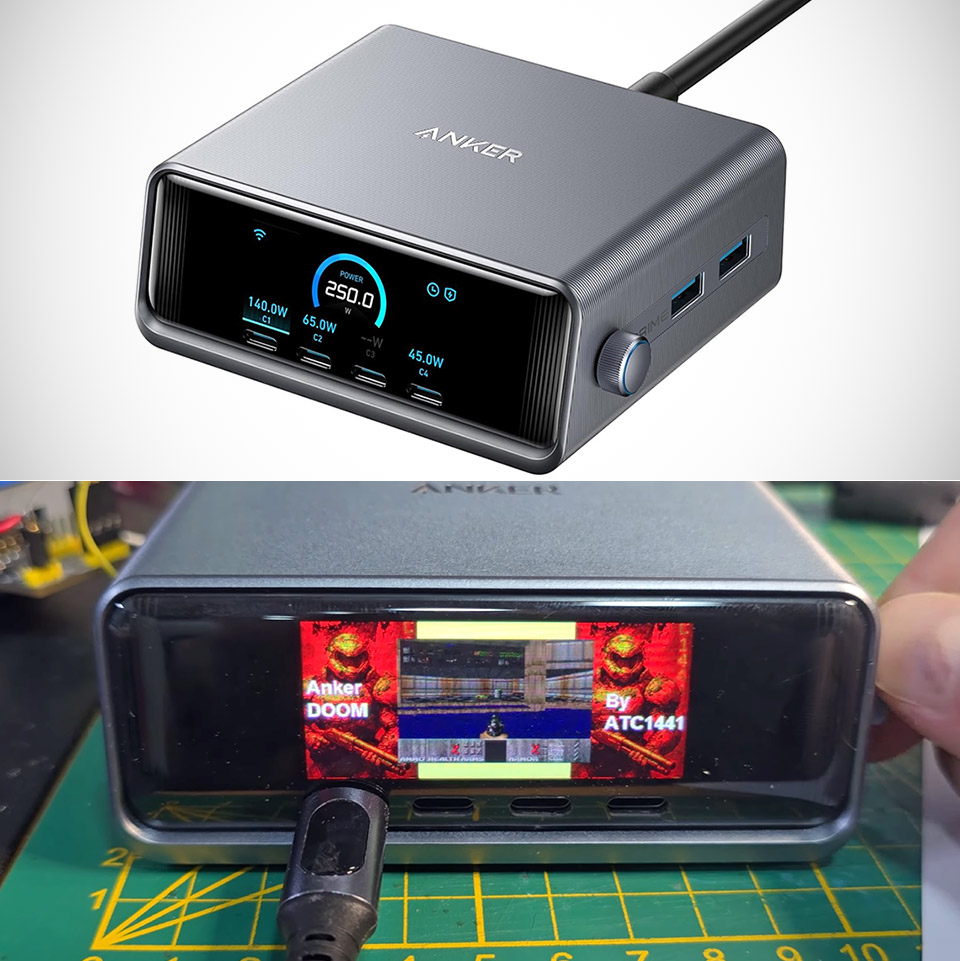
You wouldn’t expect to see a demon-slaying, shotgun-blasting adventure unfold on a charging station. But Aaron Christophel managed to get the classic 1993 game DOOM running on the Anker Prime Charging Station.
This starts with the Anker Prime Charging Station, with its multiple ports and a 200×480-pixel LCD display. It has Bluetooth Low Energy (BLE) and Wi-Fi, so the charging station has got more going on inside than your average power brick. Christophel wanted to see if it could handle DOOM, a game that’s been ported to everything from calculators to smart fridges.
Sale

Anker Prime Charging Station, 250W 6-Port GaN USB C Charger, 2.26" LCD Smart Display Control, Compatible...
- Super Fast 250W Output: Experience the convenience of high-capacity charging with this 250W desktop charger, featuring four USB-C and two USB-A ports...
- High-Efficiency Charger: Power up your 16-inch MacBook Pro to 50% in just 25 minutes using the first USB-C port, which delivers 140W to significantly...
- Instant Power Feedback: Monitor your charging in real time with the 2.26-inch LCD display, providing visual feedback on charging status and speed.
Inside, Christophel found a dual-processor setup. An ESP32-C3 microcontroller handles the Bluetooth connectivity—a capable chip in its own right, often found in IoT devices. But the real star was the Synwit SWM341RET7, a 150 MHz ARM-based microcontroller with an ARMv8-M architecture. This chip is relatively unknown and documented mostly in Chinese, comes with 16 MB of external flash storage and 8 MB of external RAM, both directly mapped to the processor’s memory space.
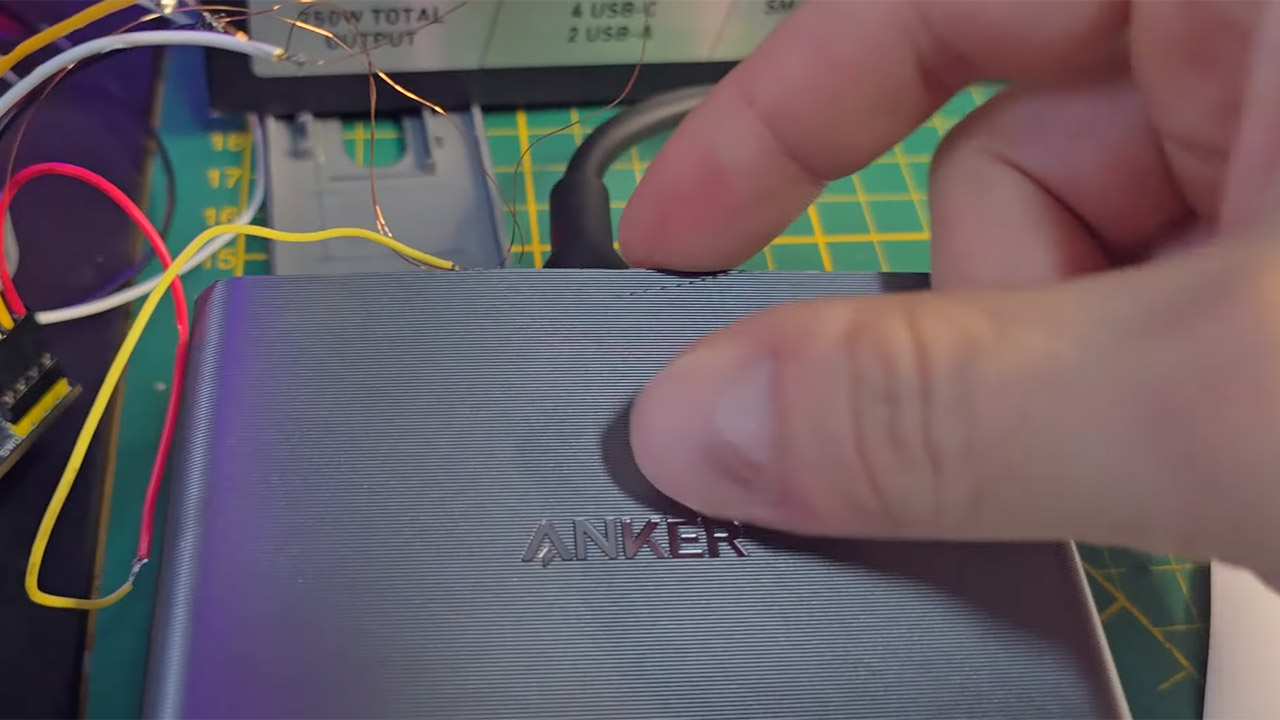
Getting DOOM to run on this setup required navigating the Synwit chip’s unique architecture. Unlike the ESP32-C3 which could theoretically run DOOM but wasn’t connected to the display, the Synwit chip controlled the 200×480-pixel LCD. Christophel needed to program this chip to handle the game’s graphics and logic. Fortunately the Synwit’s memory mapping made this possible. The 16 MB of flash memory provided ample room for the DOOM game files, and the 8 MB of RAM was considerable for an embedded device. Full-screen mode strained the hardware and produced slowdowns, but a slightly reduced resolution kept things running smoothly.
Programming the Synwit chip wasn’t easy. Christophel accessed the device’s debugging header, a physical interface that allowed him to upload custom firmware. This header, located on the outside of the charging station, was the key to reprogram the device without any hardware modifications. He wrote custom code to adapt DOOM’s engine to the Synwit’s ARMv8-M architecture, using the memory-mapped flash and RAM to store and process the game’s assets. He compiled a version of DOOM for the chip so the game could render on the LCD and be playable.
The Anker Prime Charging Station isn’t a gaming console – it doesn’t have a joystick or buttons for fast paced action. Instead. it has a single clicky encoder, a rotating dial that doubles as a push button. Christophel mapped the game’s controls to this minimalist input: pushing the encoder fires weapons or opens doors, rotating it moves the player up or down, and combining a push with rotation handles left and right movement.
[Source]