
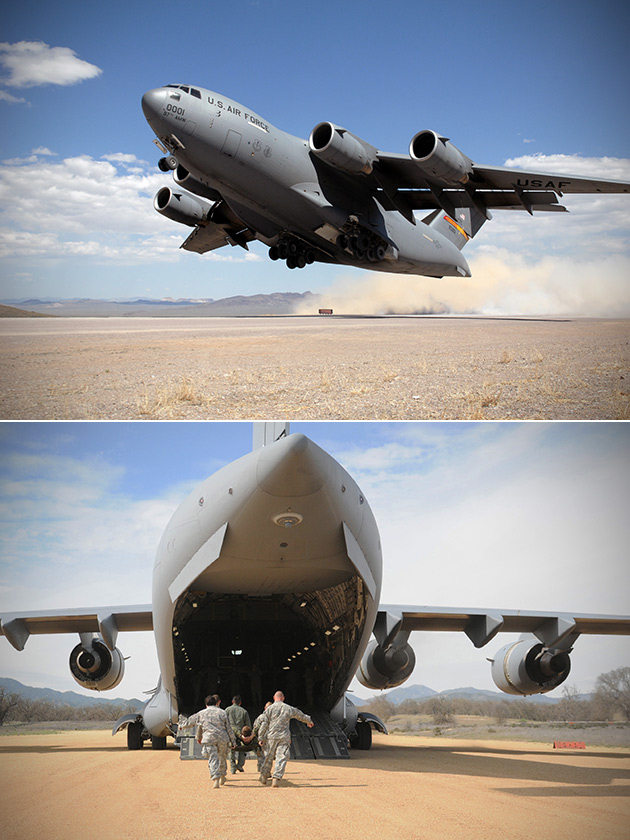

The Boeing C-17 Globemaster III is currently the world’s third largest military transport aircraft. It was developed for the United States Air Force (USAF) by McDonnell Douglas, and commonly performs strategic airlift missions, transporting troops and cargo throughout the world; additional roles include tactical airlift, medical evacuation and airdrop duties.
5. Maximum Takeoff Weight of 585,000-Pounds

Maximum payload of the C-17 is 170,900 lb (77,500 kg), and its Maximum takeoff weight is 585,000 lb (265,350 kg). With a payload of 160,000 lb (72,600 kg) and an initial cruise altitude of 28,000 ft (8,500 m), the C-17 has an unrefueled range of about 2,400 nautical miles (4,400 km) on the first 71 aircraft, and 2,800 nautical miles (5,200 km) on all subsequent extended-range models that include a sealed center wing bay as a fuel tank.

- 𝗟𝗶𝗴𝗵𝘁𝘄𝗲𝗶𝗴𝗵𝘁 𝗮𝗻𝗱 𝗣𝗼𝗿𝘁𝗮𝗯𝗹𝗲 - The drone is lightweight and compact, weighing...
- 𝗡𝗼 𝗥𝗲𝗴𝗶𝘀𝘁𝗿𝗮𝘁𝗶𝗼𝗻 𝗡𝗲𝗲𝗱𝗲𝗱 - Under 249 g, FAA Registration and Remote ID are not required if...
- 𝗘𝘅𝘁𝗲𝗻𝗱𝗲𝗱 𝗙𝗹𝗶𝗴𝗵𝘁 𝗧𝗶𝗺𝗲 - Enjoy longer flights with DJI Mini 2 SE, which offers a 31-min max flight...
4. Can Operate on Short Runways

The C-17 is designed to operate from runways as short as 3,500 ft (1,064 m) and as narrow as 90 ft (27 m). In addition, the C-17 can operate from unpaved, unimproved runways (although with greater chance of damage to the aircraft). The thrust reversers can be used to back the aircraft and reverse direction on narrow taxiways using a three- (or more) point turn. The plane is designed for 20 man-hours of maintenance per flight hour, and a 74% mission availability rate.
3. Cargo Operations Only Requires 3 Members

For cargo operations the C-17 requires a crew of three: pilot, copilot, and loadmaster. The cargo compartment is 88 feet (26.82 m) long by 18 feet (5.49 m) wide by 12 feet 4 inches (3.76 m) high. The cargo floor has rollers for palletized cargo but it can be flipped to provide a flat floor suitable for vehicles and other rolling stock. Cargo is loaded through a large aft ramp that accommodates rolling stock, such as a 69-ton (63-metric ton) M1 Abrams main battle tank, other armored vehicles, trucks, and trailers, along with palletized cargo.
2. Powered by Four Turbofan Engines
The C-17 is powered by four Pratt & Whitney F117-PW-100 turbofan engines, which are based on the commercial Pratt and Whitney PW2040 used on the Boeing 757. Each engine is rated at 40,400 lbf (180 kN) of thrust. The engine’s thrust reversers direct engine exhaust air upwards and forward, reducing the chances of foreign object damage by ingestion of runway debris, and providing enough reverse thrust to back the aircraft up on the ground while taxiing.
1. No Longer in Production
In October 2014, the main wing spar of the 279th and last aircraft was completed, this C-17 shall be delivered in 2015, after which Boeing will close the Long Beach plant. Production of spare components shall continue until at least 2017. The C-17 is projected to be in service for several decades.
