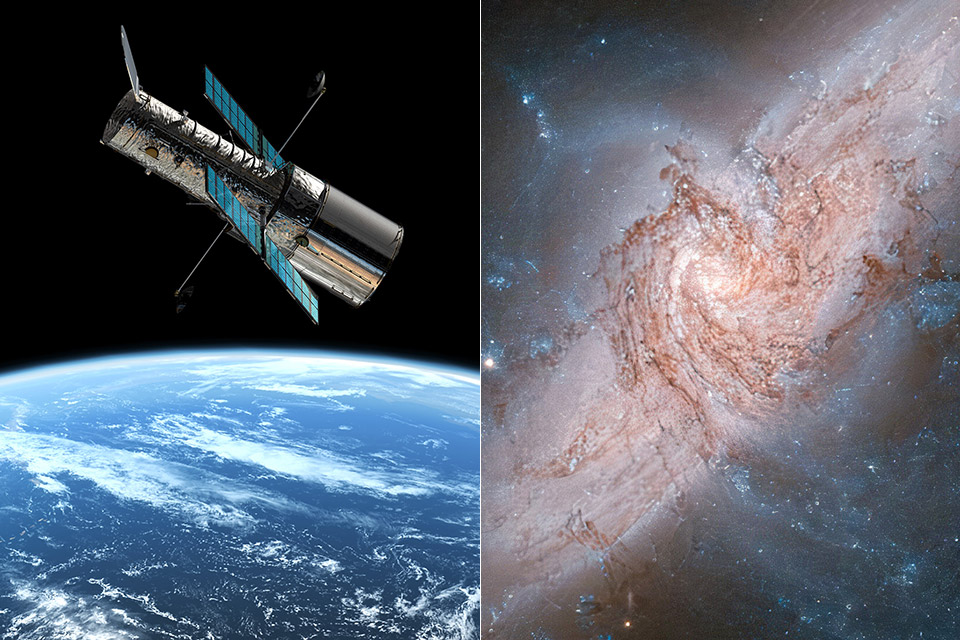
NASA / ESA’s Hubble Space Telescope captured a fascinating image of overlapping spiral galaxies, classified as NGC 3314, located between 117 and 140 million light-years from Earth. These two galaxies may look to be intersecting and colliding, but it’s just a trick of perspective.

In reality, these two galaxies – NGC 3314A and NGC 3314B – are separated by tens of millions of light-years, about 10 times the distance between our Milky Way Galaxy and the Andromeda Galaxy. The two are actually moving in different directions through space, and are most certainly not on any type of collision course with each other.

- ADVANCED TECH MEETS ICONIC DESIGN: The NexStar 8SE pairs Celestron’s legendary orange tube with a fully computerized GoTo system—ideal for those...
- 8-INCH SCHMIDT-CASSEGRAIN OPTICS: The large 8" aperture gathers enough light to reveal fine lunar details, cloud bands on Jupiter, and deep-sky...
- FULLY AUTOMATED GoTo MOUNT WITH NEXSTAR+ HAND CONTROL: Use the NexStar+ hand control to select from a 40,000+ object database. The computerized mount...
The pair resembles a hazy ‘X’ shape. The front galaxy is interlaced with dark brown dust and is surrounded by bright blue stars. The galaxy behind it is seen edge-on, at a diagonal angle tilted up at the right side,” said the NASA Hubble Mission Team.