

NASA / ESA’s Hubble Space Telescope captured this glorious image of spiral galaxy NGC 5643, which is located 40 million light-years from Earth in the constellation Lupus. Scientifically speaking, this would be classified as a grand design spiral because its two large, winding spiral arms are clear to see, defined by bright blue stars, lacy reddish-brown dust clouds and pink star-forming regions.
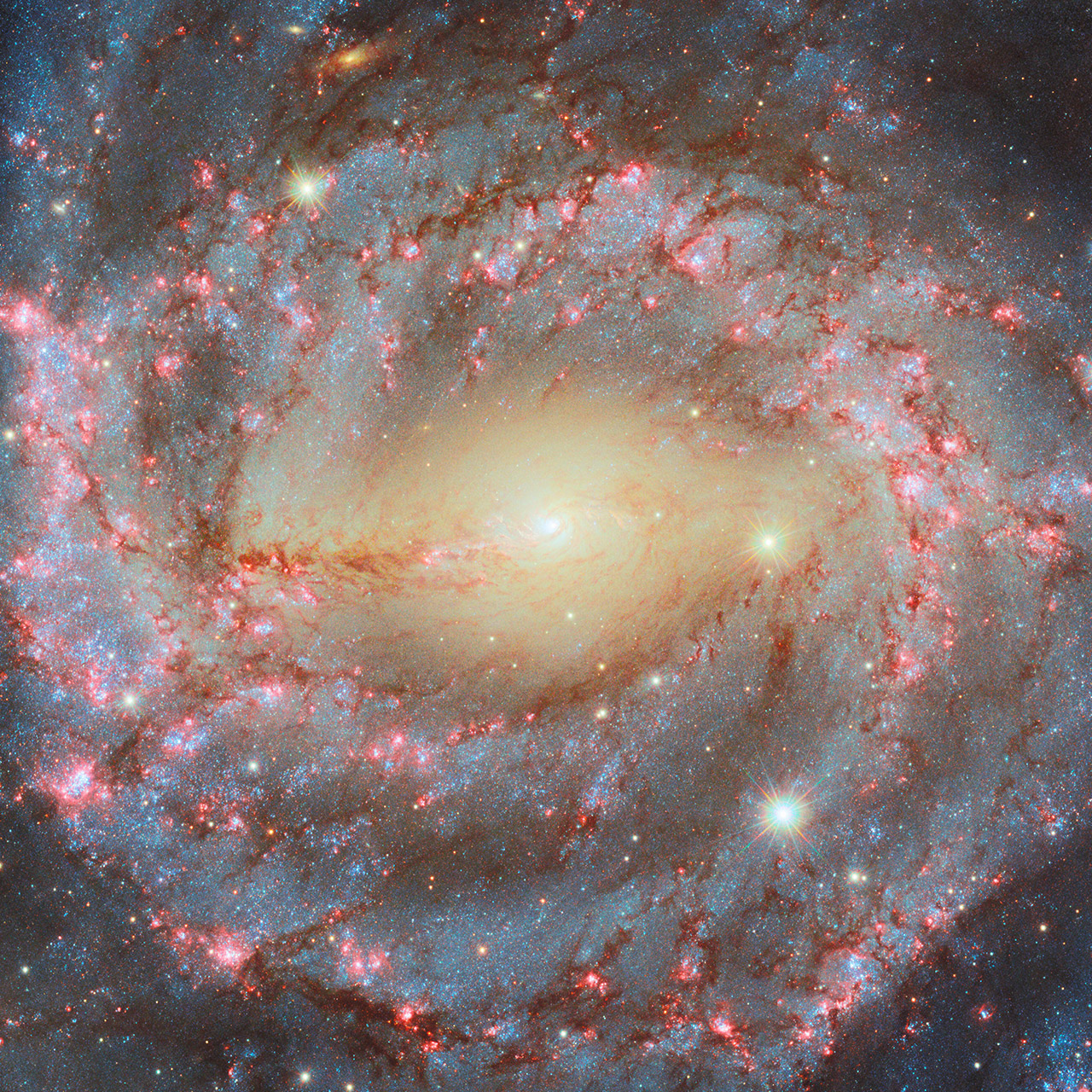
Despite how grand it looks, NGC 5643’s most interesting features are invisible to the human eye, and can only be revealed in ultraviolet as well as X-ray images. How so? It is home to an active galactic nucleus, or an especially bright galactic core powered by a feasting supermassive black hole. That’s right, when the latter captures gas from its surroundings, it’s collected in a disc that heats up to hundreds of thousands of degrees, resulting in a light show that shines across the electromagnetic spectrum, especially at X-ray wavelengths.

- Superior Optics: 400mm(f/5.7) focal length and 70mm aperture, fully coated optics glass lens with high transmission coatings creates stunning images...
- Magnification: Come with two replaceable eyepieces and one 3x Barlow lens.3x Barlow lens trebles the magnifying power of each eyepiece. 5x24 finder...
- Wireless Remote: This refractor telescope includes one smart phone adapter and one Wireless camera remote to explore the nature of the world easily...
A close-up of a spiral galaxy, seen face-on. Its center is a bright white point, surrounded by a large yellowish oval with thin lines of dust swirling in it. From the sides of the oval emerge two bright spiral arms which wind through the round disc of the galaxy, filled with shining pink spots where stars are forming and more dark reddish dust. Many stars can be seen in the foreground, over and around the galaxy,” said the ESA.