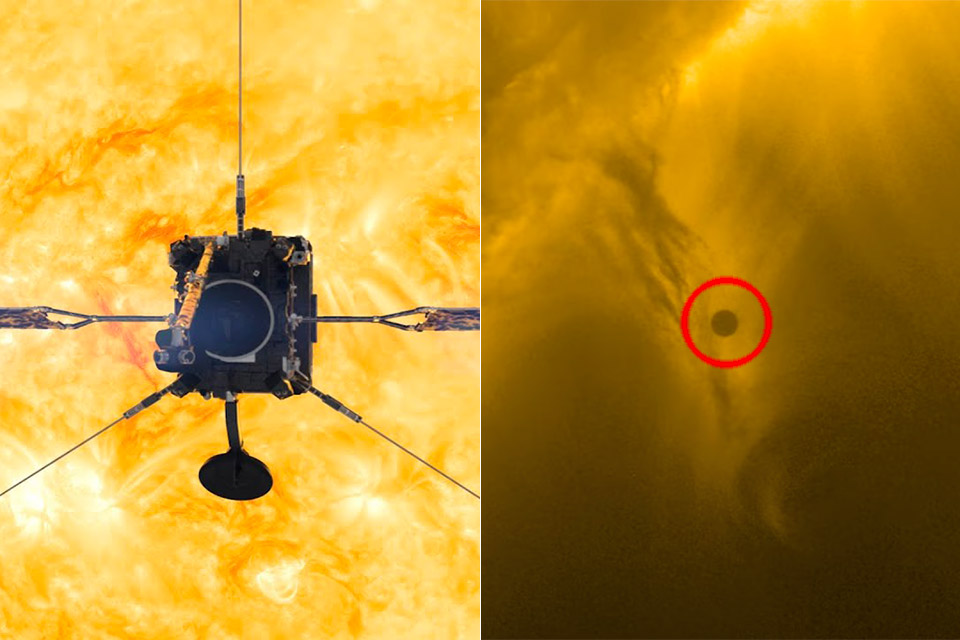
NASA / ESA’s Solar Orbiter used its Extreme Ultraviolet Imager (EUI) to capture Mercury transiting the Sun. The planet appears just after leaving the disc and as a silhouetted figure in front of gaseous structures in the Sun’s atmosphere. Its Spectral Imaging of the Coronal Environment (SPICE) instrument splits light from the Sun into its constituent colors to isolate the light from different atoms in its lower atmosphere.
How can transits help astronomers? They are used to help find planets around other stars. As the planet moves across the face of the star, the bright surface is partially covered by the planet’s silhouette, resulting in a slight dimming. By studying this repeating pattern, astronomers are able to calculate the planet’s size and orbit.

- Detailed Lunar Replica - Features a detailed Eagle lunar lander replica with lunar surface, crater, footprints, and U.S. flag for a realistic space...
- Realistic Modular Model - This modular set includes a descent stage with gold-colored landing pads, panels, opening camera, laser hatches, and movable...
- Ascent Stage Interior - The ascent stage boasts a detailed interior with room for 2 astronaut minifigures, finished with an Apollo 11 Lunar Lander...
It’s not just looking at Mercury passing in front of the Sun, but passing in front of the different layers of the atmosphere,” said Miho Janvier, Institut d’Astrophysique Spatiale, France, the SPICE deputy project scientist who is currently on secondment to ESA.