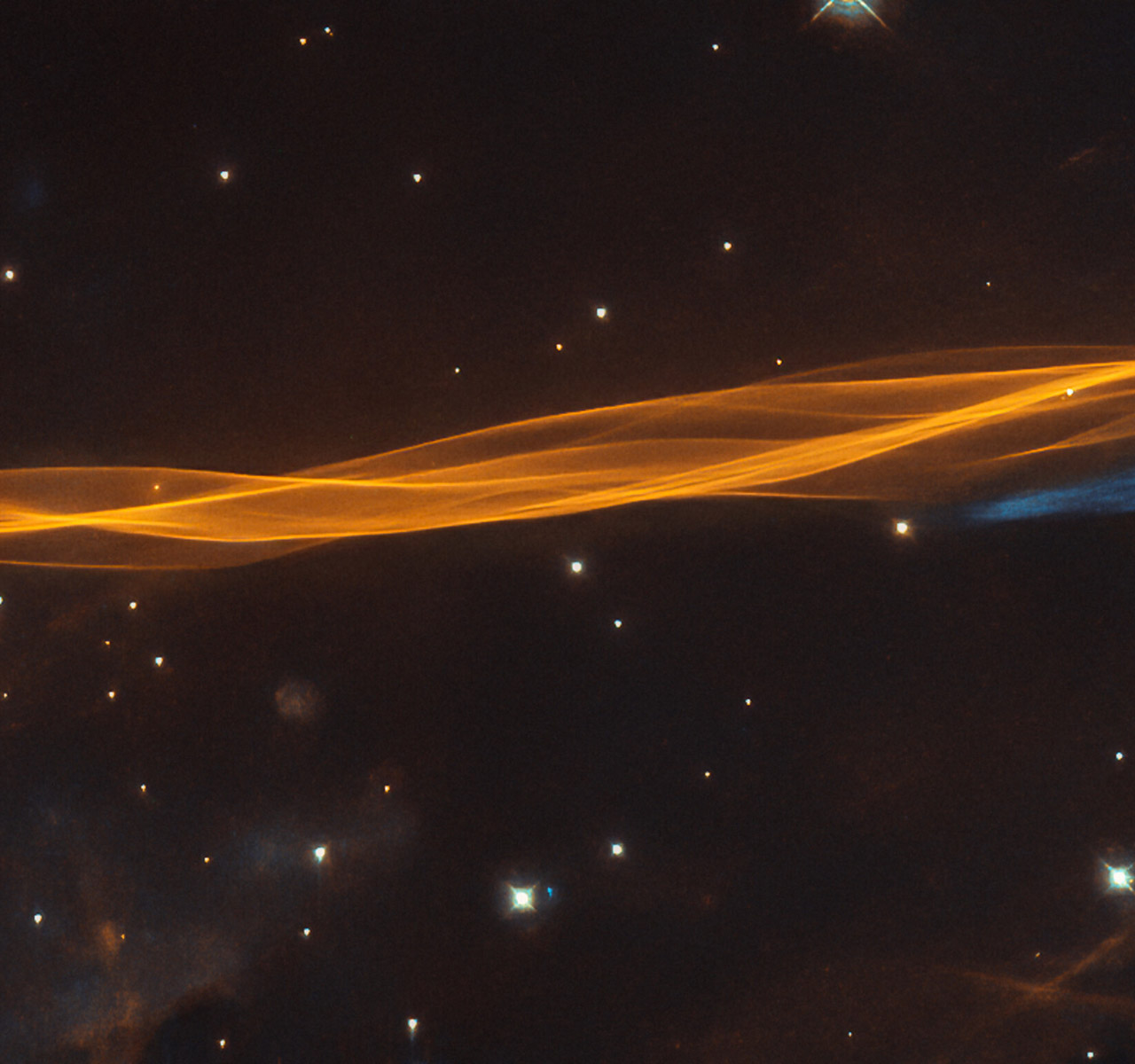

Photo credit: ESA/Hubble & NASA, W. Blair; acknowledgment: Leo Shatz
NASA/ESA’s Hubble Space Telescope captured an amazing image that shows a small section of the Cygnus supernova blast wave, located approximately 2,400 light-years away. This supernova remnant got its name from its position in the northern constellation of Cygnus (the Swan), where it spans an area 36 times larger than the full Moon. On a related note, Cygnus contains Deneb, one of the brightest stars in the night sky and the most distant first-magnitude star as its “tail star”.
The original supernova explosion tore apart a dying star about 20 times more massive than our Sun between 10,000-20,000 years ago. Since that time, the remnant has expanded 60 light-years from its center.

- POWERFUL TELESCOPE FOR ASTRONOMY BEGINNERS: The AstroMaster 130EQ delivers sharp optics, a stable equatorial mount, and smooth manual controls, making...
- HIGH-QUALITY 130MM OPTICS: Enjoy views through the 130mm (5”) Newtonian reflector, which features high-quality aluminum and SiO₂ coatings and...
- SMOOTH, ACCURATE POINTING: Effortlessly aim and center your target using the two slow-motion control knobs for right ascension and declination whether...
The shockwave marks the outer edge of the supernova remnant and continues to expand at around 220 miles per second. The interaction of the ejected material and the low-density interstellar material swept up by the shockwave forms the distinctive veil-like structure seen in this image,” said NASA.