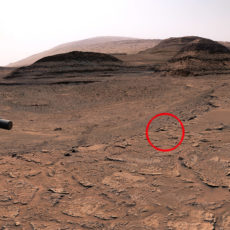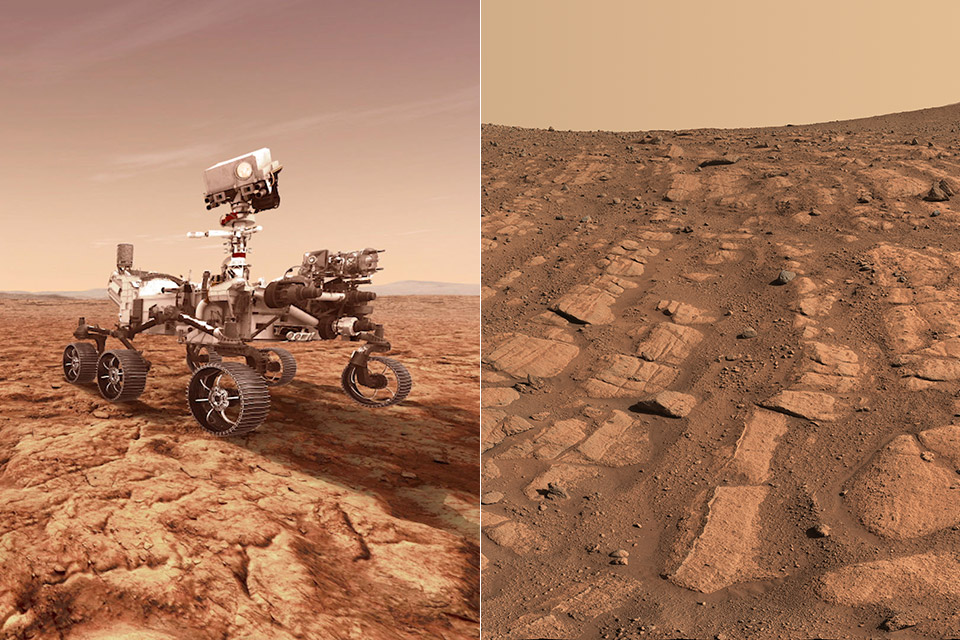
NASA’s Perseverance Mars Rover‘s Mastcam-Z camera recently captured bands of rocks that may have been formed by a very fast flowing, ancient river. The mosaic consists of 203 individual images that were stitched together after being transmitter from Mars and when viewed from the ground, the curved layers appear to ripple out across the landscape.

A second mosaic (below) depicts a separate location, Pinestand, that is part of the curvilinear unit and approximately a 450-meters from the first location, Skrinkle Haven. This isolated hill boasts sedimentary layers that curve skyward, some as high as 20-meters, and scientists believe they may also have been formed by a turbulent river. Their next objective is to peer below the surface, using the ground-penetrating radar instrument on Perseverance called RIMFAX (Radar Imager for Mars’ Subsurface Experiment).

- BRIGHT, SHARP VIEWS ANYWHERE: Unlike many beginner telescopes, this quality refractor features fully coated glass lenses and a 70mm aperture for...
- PERFECT FIRST TELESCOPE FOR BEGINNERS: Designed for adults and kids to enjoy together, this beginner-friendly telescope sets up in minutes and...
- EASY NO-TOOL SETUP: No complicated assembly or tools needed. The full-height tripod and telescope tube set up in seconds and pack neatly into the...

Those indicate a high-energy river that’s truckin’ and carrying a lot of debris. The more powerful the flow of water, the more easily it’s able to move larger pieces of material. It’s been a delight to look at rocks on another planet and see processes that are so familiar,” said Libby Ives, a postdoctoral researcher at NASA’s Jet Propulsion Laboratory.