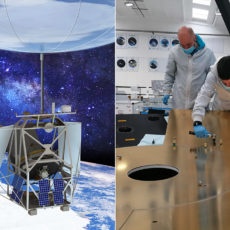
Using a balloon-borne experiment called the Antarctic Impulsive Transient Antenna (ANITA), scientists detected bizarre radio signals rising from deep beneath the ice that defy the rules of physics as we know them.
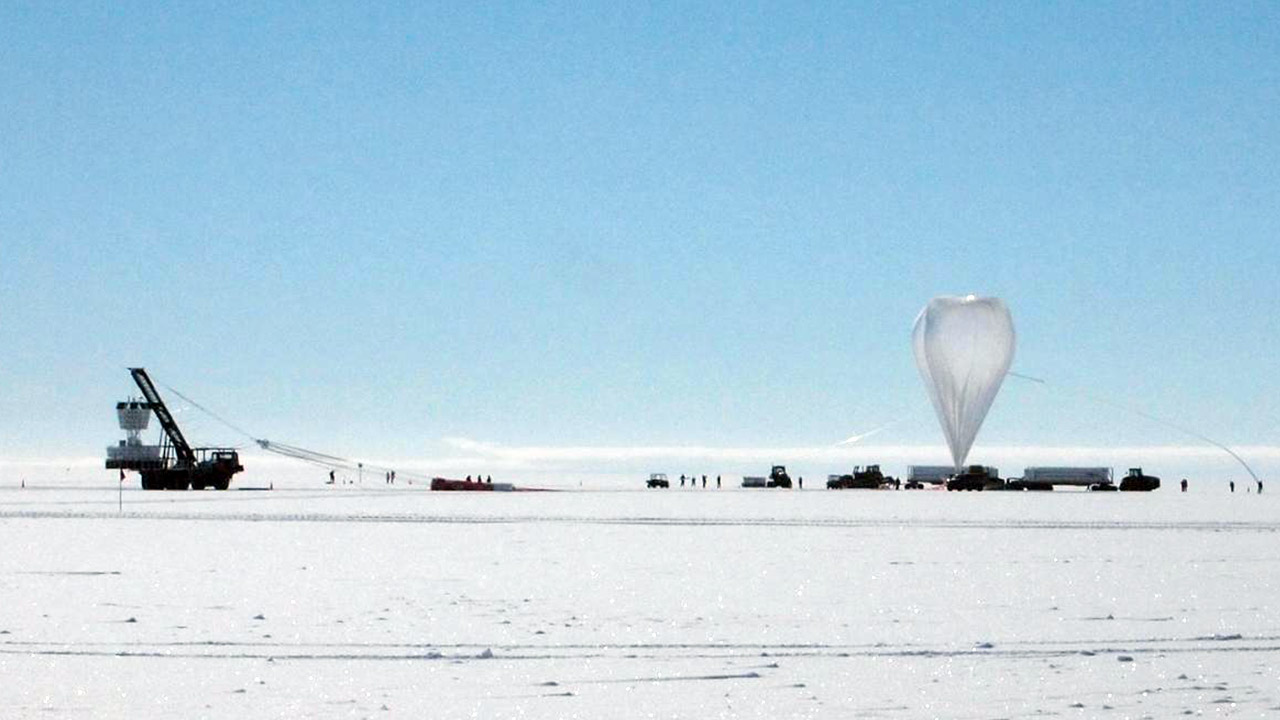
Hoisted 19 to 24 miles above Antarctica on NASA balloons, its radio antennas scan the ice below for fleeting bursts of energy, known as “ice showers”. When they slam into the ice, they trigger cascades of secondary particles that emit radio waves. With minimal human activity, radio interference is virtually nonexistent, letting ANITA listen for cosmic whispers from distant galaxies. “We point our antennas down at the ice and look for neutrinos that interact in the ice, producing radio emissions that we can then sense on our detectors,” explains Stephanie Wissel, an associate professor of physics at Penn State and a key player on the ANITA team.

- Multi-model ocean exploration building playset – Hours of action-packed, ocean-themed adventures await with this LEGO City Arctic Explorer Ship...
- What’s in the box? – Everything kids need to build a toy exploration ship, helicopter, dinghy, ROV submarine and Viking shipwreck, plus...
- Features and functions – Kids can float the ship on water and deploy the ROV submarine with the ship’s telescopic crane arm
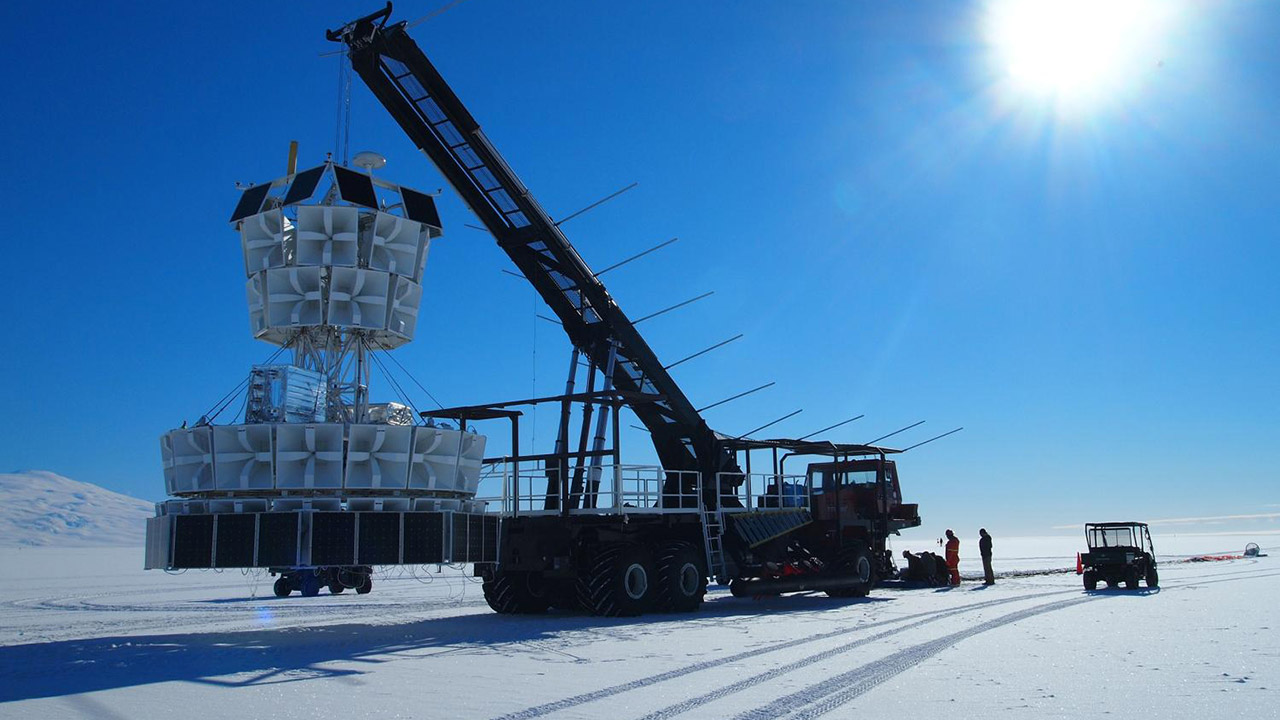
Photo credit: Stephanie Wissel / Penn State
Here’s where things get strange. Between 2006-2016, ANITA picked up strange radio pulses that seemed to originate from deep below rather than bounce off the ice, rising at steep angles. According to Wissel, this implies the waves traveled through thousands of kilometers of solid rock, something current physics says is impossible. “By the time such a signal emerged, it should have been absorbed,” she notes. “The math just didn’t add up.” The rock and ice should have swallowed these pulses long before they reached ANITA’s antennas, yet there they were, clear and confounding.
Neutrinos were the first suspect. Since these particles can pass through matter with ease, they earned them the nickname “ghost particles.” Could they be responsible for the rogue signals? The team verified ANITA’s data with two other projects in neutrino detection: Antarctica’s IceCube Experiment and Argentina’s Pierre Auger Observatory Neither registered anything that could explain ANITA’s findings. “Analysis revealed the other detectors did not register anything that could have explained what ANITA detected,” Wissel says, labeling the signals “anomalous.” She’s blunt about the implications: “The particles causing the strange signals are not neutrinos.”

So, if not neutrinos, what are these signals? The team’s paper, published in Physical Review Letters, doesn’t offer answers but raises tantalizing possibilities. Could the pulses point to new particles beyond the Standard Model of particle physics? Dark matter, a mysterious substance thought to make up roughly 27% of the universe’s mass, has been floated as a candidate, though Wissel cautions that the lack of corroborating data from IceCube and Auger “narrows the possibilities.” Another theory suggests exotic radio propagation effects near the ice or horizon, but Wissel admits, “We haven’t been able to find any of those yet either.” For now, the signals remain a cosmic riddle.
Antarctica’s ice sheet, holding 70% of Earth’s freshwater, is more than a backdrop—it’s a natural laboratory. ANITA exploits the continent’s vast, undisturbed ice to catch signals that would be drowned out elsewhere. The experiment’s balloons float high enough to survey over a million cubic kilometers of ice, a volume that boggles the mind. Yet, the signals’ upward trajectory suggests they’re emerging from beneath this frozen shield, possibly from the Earth’s crust itself. This defies not just physics but intuition—how does a radio wave punch through solid rock to ping a balloon 24 miles up?
Wissel and her colleagues aren’t giving up. A new experiment, dubbed PUEO (Payload for Ultrahigh Energy Observations), is in the works. More sensitive and powerful than ANITA, PUEO could zero in on the signals’ origins. “I’m hopeful that PUEO will be sensitive and powerful enough to help physicists determine the origin of the strange signal,” Wissel says.
[Source]