
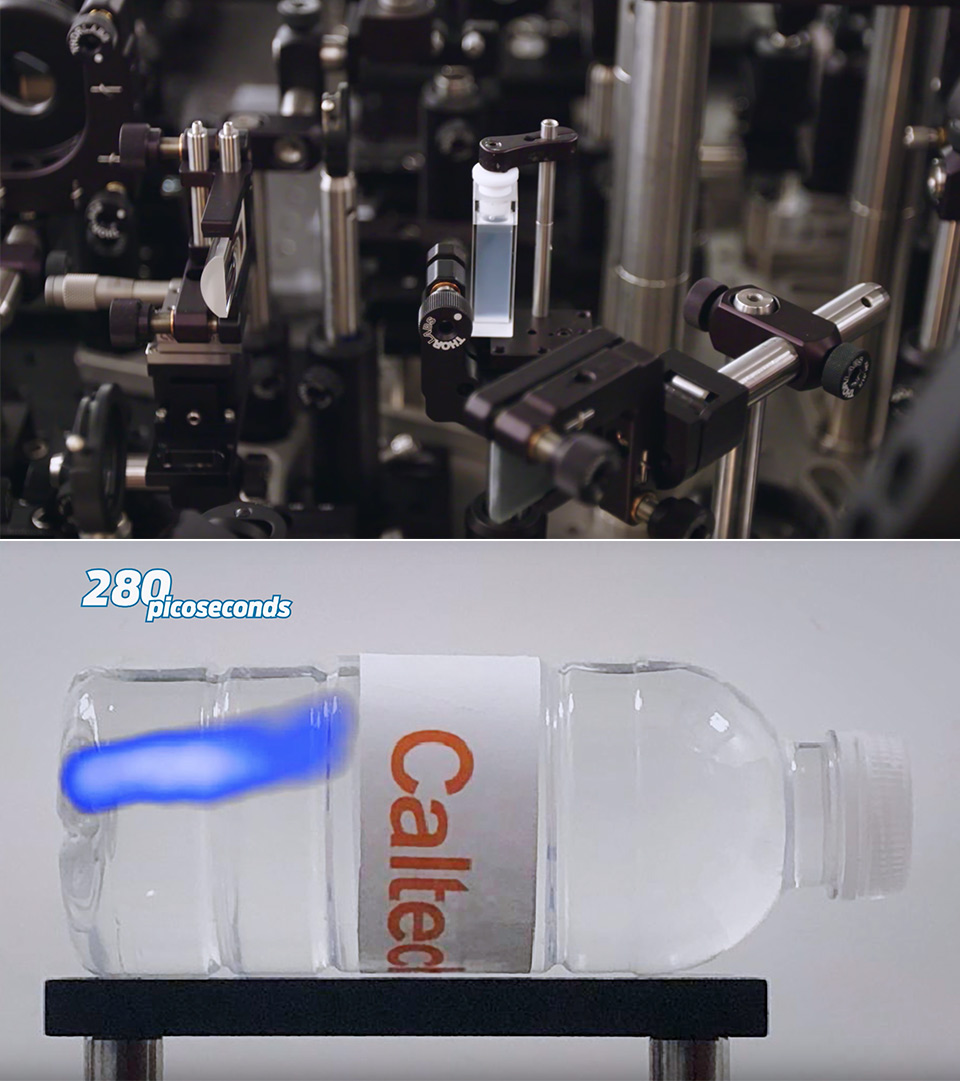

National de la Recherche Scientifique (INRS) and CalTech researchers have developed T-CUP, the world’s fastest camera, and it’s capable of capturing ten trillion (1013) frames per second (fps), thus making it possible to literally freeze time to see phenomena – and even light – in extremely slow motion. The Slow Mo Guys met up with postdoctoral scholar Peng Wang to capture the speed of light at 10 trillion frames per second, so they diluted the water with a small amount of milk, in which the camera then records the beam of light as it travels across a few millimeters of that diluted milk.
The entire process takes about 50 picoseconds. CalTech hopes to one day increase the fastest speed of its camera to one quadrillion frames per second. This camera is based on a technique called femto-photography. Particles of light are converted into electrons as they pass through a narrow slit, which allows the camera to take images at 10 trillion frames a second. The technology could have huge implications for medical and scientific research.

- Capture. Charge. Get a Highlight Video Automatically
- Revolutionary New Image Sensor
- Unbelievable Image Quality

