ETH Zurich researchers have developed a solar tower in Spain capable of making carbon-neutral jet fuel from water, carbon dioxide and sunlight. How does it work? The tower concentrates solar thermal energy over 169 sun-tracking reflector panels, each with three square meters of surface area. These panels redirect sunlight into a 16-cm hole in the solar reactor atop the 49-foot central tower.

A research team in China has just unveiled ‘Tianjin’, a 100% solar car equipped with several autonomous technologies. They claim it never needs to charged, nor does it require additional power sources, thus making the vehicle truly emission-free. It weighs in at just 2248-pounds and has a solar module that spans 8.1 square meters, generating a maximum of 7.6 kWh of electricity per day in perfect weather.

Photo credit: Adri
Spotted at Germany’s IdeenExpo, this Tesla Solar trailer is apparently a range extender for their EVs, complete with SpaceX Starlink high-speed internet. It features nine individual Tesla Solar panels, with each one producing approximately 300W, giving the entire array 2.7 kW of charging power. Starlink could be used for communications purposes in case of emergency where there is no cell coverage.

Photo credit: Nina Vaidya
Stanford University researchers, led by engineering researcher Nina Vaidya, have developed an optical concentrator that can be used to gather and concentrate light, regardless of the angle or frequency of that light. Called AGILE (Axially Graded Index Lens), it resembles an upside-down pyramid with the point lopped off, allowing light to enter the square, while the tile-able top funnels it downwards to create a brighter spot at the output.

After many years of design and testing, the Lightyear 0 is finally going into production this fall as the world’s first solar car. In optimal conditions, the vehicle is capable of freely traveling for up to seven months without having to be plugged into a household outlet or charging station.

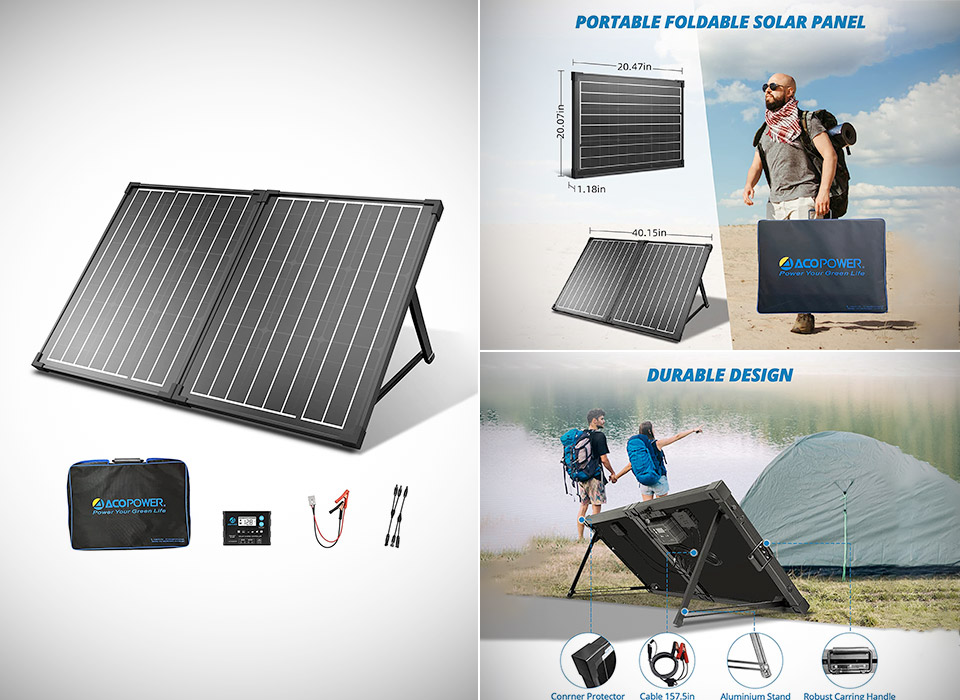
The ACOPOWER 100W 12V Foldable Solar Panel Suitcase Kit is great for RVs or outdoor camping trips, and you can get one for $149.99 shipped with coupon code: 50A99YT2, today only, originally $299.99. You get two fully waterproof and dustproof 50W monocrystalline solar panels, complete with a built-in 5-stage solar charge controller for overcharge protection. Product page – be sure to enter coupon code: 50A99YT2 during final checkout for the additional discount.

Forget electric scooters, the Squad Solar City Car is here, and it doesn’t even require a license to drive in some EU countries. Priced from $6533 USD, this solar electric vehicle (SEV) is powered by dual 2-kW in-wheel rear motors that produce a combined 5 hp and are good for a top speed of 28 mph, while its lithium-ion batteries boast a 62-mile range on a full charge.

The UK has plans to build a solar power plant in space and it could have a demonstrator in orbit by 2035. London’s Space Energy Initiative wants to make this a reality since solar-based energy has very low environmental footprint and needs only modest infrastructure on Earth, either on land or coastal areas, while generating large scale electricity at minimal cost.

Night solar panels sound like something from a science fiction movie, but a team of Stanford engineers has made them a reality. How do they work? The system essentially harvests energy that is transferred between the solar panels back into space at night – also known as radiative cooling – by incorporating a thermoelectric generator. The latter basically captures the heat flowing between the warm air and solar panels, eventually transforming it into energy.

Photo credit: Felice Frankel
Engineers from MIT and the National Renewable Energy Laboratory (NREL) have designed a heat engine with zero moving parts, yet it’s still capable of converting heat to electricity with over 40% efficiency. Simply put, it’s a thermophotovoltaic (TPV) cell, similar to a solar panel’s photovoltaic cells, that passively traps high-energy photons from an immensely hot (between 1,900 to 2,400° Celsius) heat source and then proceeds to convert them into electricity.