
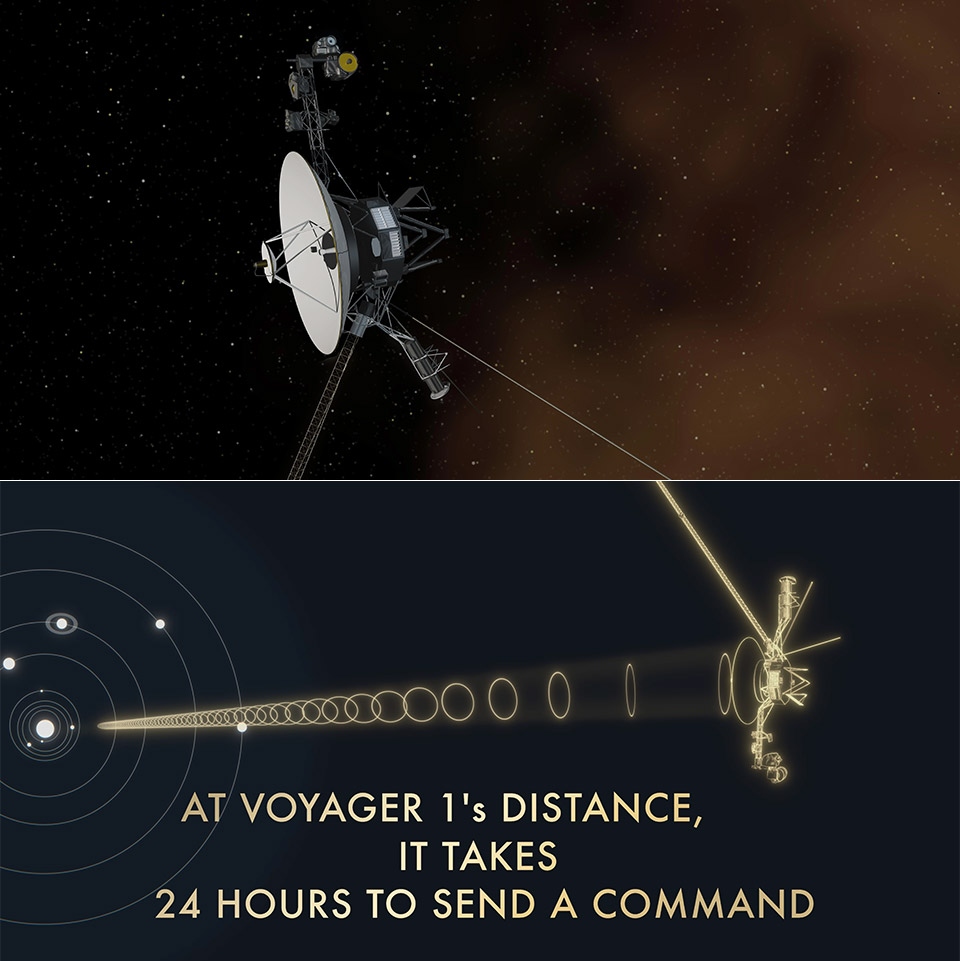
On Wednesday morning at 5:16 a.m. Eastern time, NASA’s Voyager 1 crossed a distance that no other machine built by people has ever covered. The spacecraft sat 16,094,799,096 miles from Earth, the exact span light travels in twenty-four hours. A radio signal sent from the ground now needs a full day to reach the probe, and any reply needs another full day to return. Voyager 1 has been flying since September 5, 1977, and the trip to this point took forty-nine years, two months, and eleven days.
Light travels at 186,000 miles per second, which translates to approximately 16.1 billion miles or 25.9 billion kilometers in a single light day. In contrast, the Voyager 1 spacecraft travels at a rate of around 38,000 miles per hour relative to the Sun. Its relative speed means that even at this rate, the spaceship will take decades to reach the next light day, after which a command that used to arrive in minutes must now be given with patience that can last a whole 24 hours or more. The Jet Propulsion Laboratory plans their next move, well aware that confirmation of their activities will not arrive until the next afternoon.

- BUILD AN OFFICIAL NASA ROCKET – Kids prepare to explore outer space with the LEGO Technic NASA Artemis Space Launch System Rocket (42221) building...
- 3-STAGE ROCKET SEPARATION – Young builders can turn the hand crank to watch the rocket separate in 3 distinct stages: solid rocket boosters, core...
- STEM BUILDING TOY FOR KIDS – This educational rocket kit was created in collaboration with NASA and ESA to showcase the authentic system that will...
Voyager 1 was launched 16 days after its twin, Voyager 2, only to leave it in the dust and overtake Pioneer 10, becoming the farthest human-made object in 1998. It flew past Jupiter in 1979 and Saturn the following year in 1980, where it discovered volcanoes still spewing ash on Io, a thick atmosphere on Titan, and a plethora of new moons encircling both gas giants. By August 2012, it had entered interstellar space, a region of the universe composed of thin gas and dust between the stars. Only two of the research equipment, the magnetometer and the plasma wave subsystem, continue to fire on all cylinders, giving back all sorts of data on the bits it discovers well beyond the Sun’s reach.
Its power comes from three radioisotope thermoelectric generators that convert heat from plutonium decay into electricity. These began out at roughly 470 watts, but now they barely manage around 210 watts, and they lose about 4 watts per year. Last summer, the team had to get inventive, reconfiguring circuitry in a single series of orders, which involved turning off higher-power devices and switching to lower-power ones. As a result, they were able to save 10 watts and were assured that this would keep the final remaining instruments operational for another two and a half years before they needed to be turned off again. However, communication continues to rely on the Deep Space Network’s massive antennas, which must constantly point at the signal, which is so faint that it comes at a stunning 100 attowatts.
NASA commemorated the date with a public event titled Shine Bright for Voyager’s Light Day. On the evening of November 17th, people all across the world were urged to point their mobile phones, flashlights, or any other light source at the sky and flash the Morse code letters V G R. V consists of three quick flashes followed by a long one, G of two long flashes followed by a short one, and R of a short-long-short pattern. They even included a simple browser tool that automatically blinks out the pattern. This brief exercise, however, was simply symbolic, as the spacecraft’s cameras had been turned off long ago, and even the brightest beam would have spread so thinly by the time it arrived that it would be completely undetected. Still, it was a nice way to get the planet to acknowledge the spaceship, which has well exceeded all expectations and predictions since its launch, and is still going strong.
Voyager 1 wears the Golden Record around her neck, a copper disk inscribed with images of the world and its animals, natural noises, many types of music, and even spoken greetings in 55 languages. There is also a message from President Jimmy Carter and UN Secretary-General Kurt Waldheim for good measure. This disk was supposed to represent a pleasant greeting to any other civilizations that might come across Voyager 1 one day. Now, Voyager 1 is off to visit a star called Gliese 445 in the constellation Ursa Minor, which will take 40,000 years. Voyager’s twin, Voyager 2, is on a slower trajectory and will pass within one light day of Earth in November 2035. Amazingly, both of these probes are still operational, despite having a “operations crew” of fewer than a dozen people, the majority of whom were most likely not born when Voyager first launched from Earth. Crossing that distance milestone has little effect on the physical hardware, but it is significant since it will now take days rather than hours to receive a response from Voyager 1.