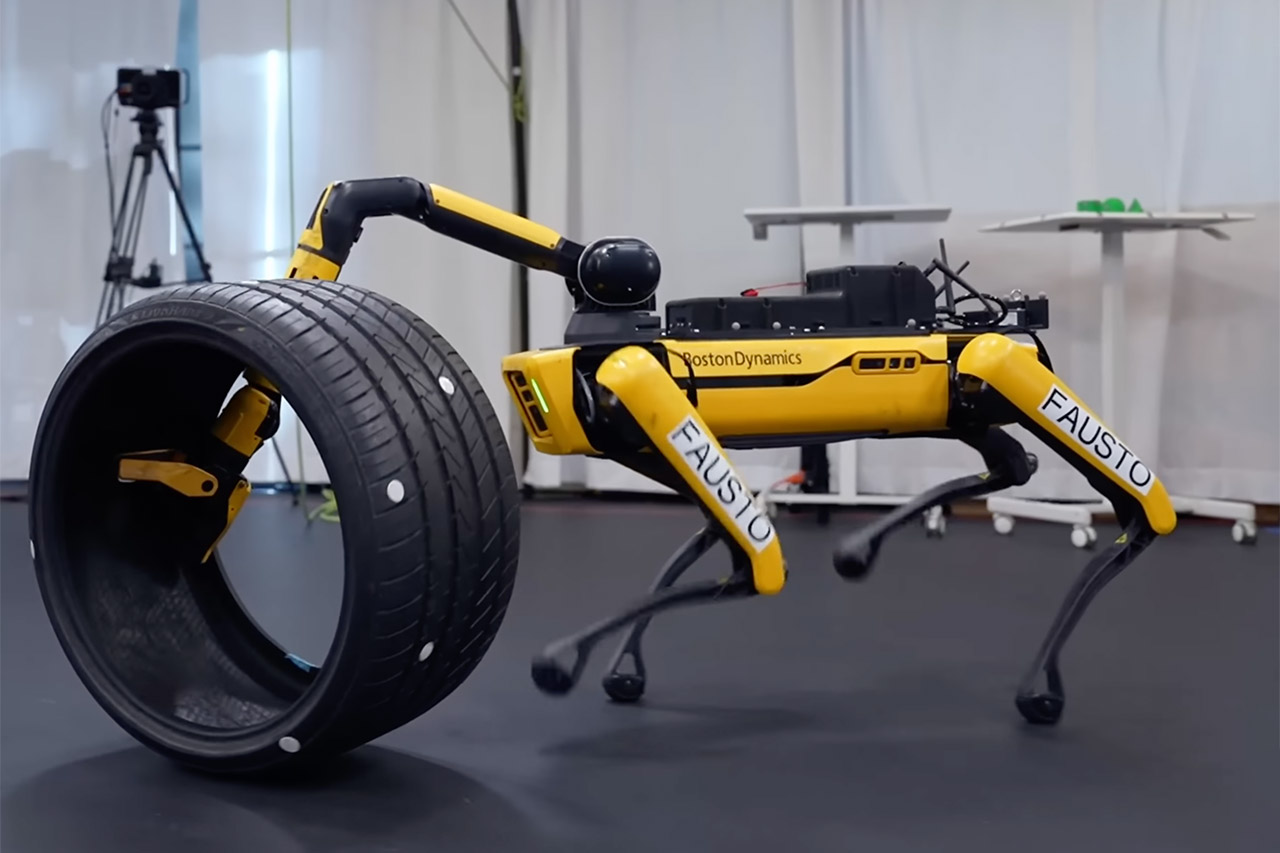
At the RAI Institute, a team of engineers have given Boston Dynamics’ Spot a whole lot more to offer than just its nimble walking abilities. They’ve managed to turn it into something that can not only pick up heavy objects but actually manhandle them with the same level of coordination you’d see from a pro working in a warehouse. The magic happens by combining two smart control methods : one that figures things out through trial and error, the other that simultaneously tries out dozens of possible paths.
Spot was already pretty impressive with its smooth gait, but this update takes it a step further – every limb gets a job to do in the action. What the researchers were after was something a bit more than the usual robot trick of grabbing onto small items with a gripper arm. No, they wanted to see Spot deal with things that can actually push back – things that have their own weight and momentum to them. In the lab, they’ve watched it drag, stack and roll these heavy things around the lab floor, all while staying on its three good legs if it needs to.
- 【Next-Generation Robotic Companion: Meet the Unitree Go2 Robotic Dog】 The Unitree Go2 Air is an intelligent quadruped robot, perfect for beginners...
- 【Intelligent Navigation with 3D LiDAR & Obstacle Avoidance】 Featuring ultra-wide 3D LiDAR with 360°x96° perception, the Go2 Air detects...
- 【High-Definition Vision & Seamless App Integration】 A front HD camera streams 1280x720 video to the app. Control the robot, view real-time data...
Beneath the surface, they’ve configured the system so that different aspects of the workload complement one other without duplicating effort. At the heart of it is a policy developed by reinforcement learning that is in charge of fundamental tasks like as keeping upright, taking a steady step, and applying the appropriate amount of torque to the motors in the legs. This part of the system was trained in a simulator called IsaacLab, where thousands of virtual Spots were created, each learning how to deal with being tossed around or shoved for hours on a single graphics card. At the top level, the system performs several functions based on the requirements. When a heavy tire needs to be flipped over, the system activates a sampling approach that generates 32 alternative futures at simultaneously, each of which is crunched on a processing thread. It uses a physics engine called MuJoCo to create routes with excellent smooth curves, all while keeping the movements fluid and the estimates as efficient as possible.
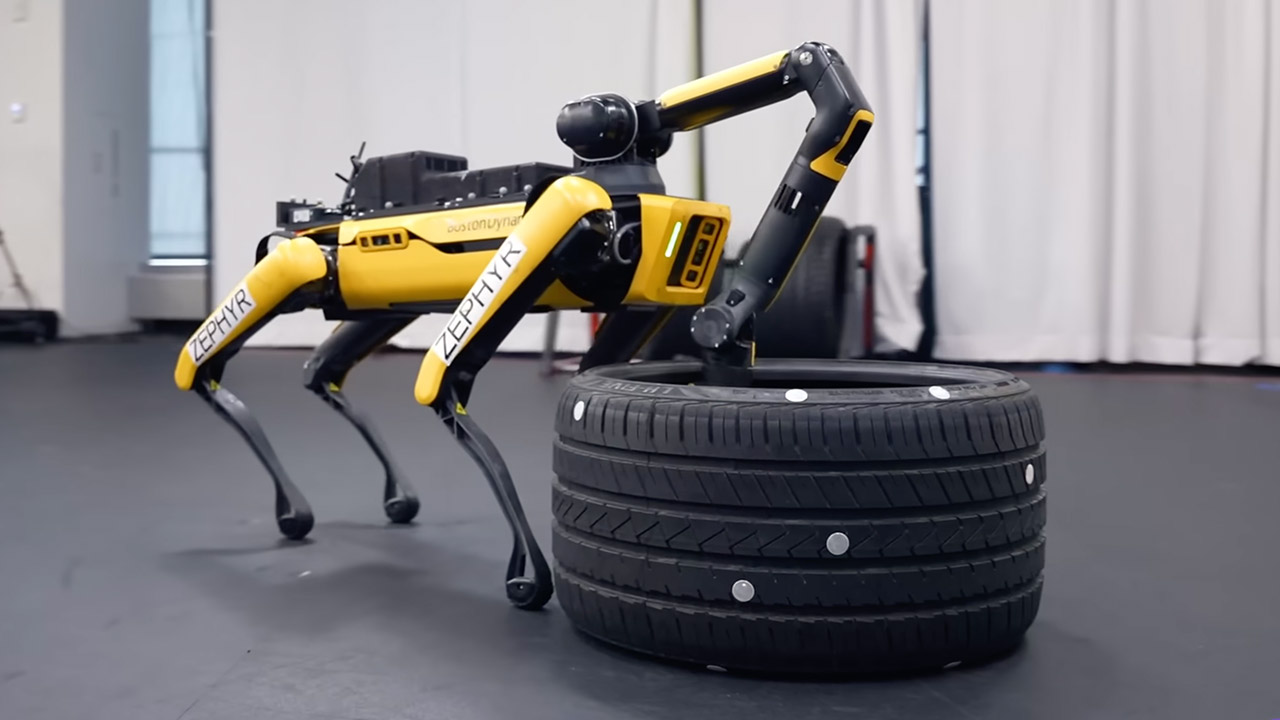
In the lab, Spot adapts on the fly: if the tire is flat against a wall, it could scoot over and hook it with the arm; if it is half-cocked, the body serves as a lever. A room full of cameras tracks every stance in real time, wirelessly transmitting data to an off-site computer that handles the hard lifting. Because of its need on external eyes and brains, it is now limited to the lab, but with onboard cameras and touch sensors, it might be used in more messy environments such as a loading dock.
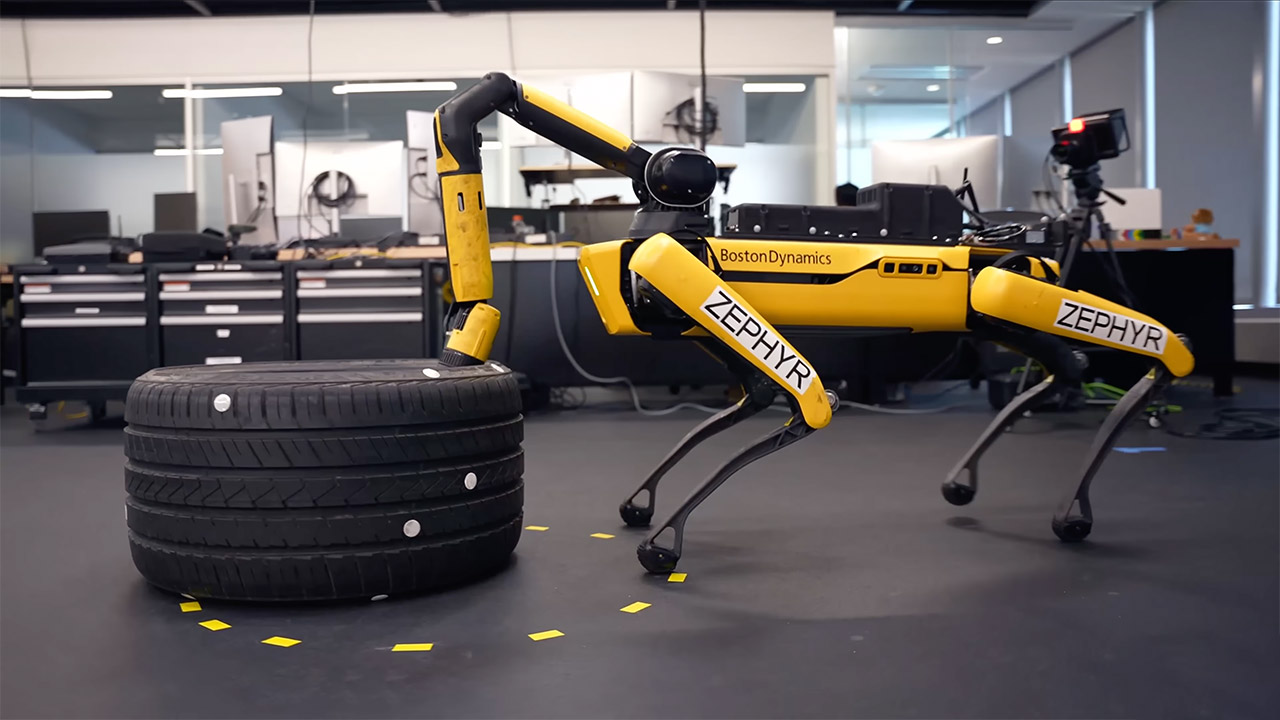
Switching to the rolling task is where reinforcement learning truly shines, transforming Spot into a tolerant sheepdog for errant wheels. Here, the high-level policy, which is also RL-trained, monitors the distance between the robot, tire, and finish line, as well as the bend and swing of its own joints. Rewards nudge it toward positions where the body hovers just so, arm extended to keep the spin stable without causing the item to veer off course. Trained with simulated mass and grip adjustments, it bridges the gap to reality by anticipating the unexpected: a tire that skids rather than slides, or one that is slightly out of round. The end result is a looping course demonstration in which Spot moves alongside, dipping low to fix drifts and darting sharply to arc around curves. Sessions last for minutes without a hiccup, and that’s what keeps you coming back to the screen, wondering how far you could push it—perhaps corralling debris after a storm or herding parts in a factory.