

NASA’s New Horizons is around 4.3-billion-miles away from Earth, and the images it captured of nearby stars are in different positions than where we would normally see them here on Earth. It’s called the “parallax effect” and one can mimic this by holding a finger approximately an arm’s length from your face to see how it jumps when you close your left or right eye. Read more for a video and additional information.
New Horizons is currently on a journey to interstellar space, similar to NASA’s Voyager probes. It flew by Pluto and its moons during 2015 before conducting observing a Kuiper Belt object, known as Arrokoth early last year. In April, 2020, New Horizons aimed its long-range telescopic camera to nearby stars Proxima Centauri and Wolf 359, which are 4.2 and 7.795 light-years away respectively, at a distance of 4.3 billion miles from Earth.
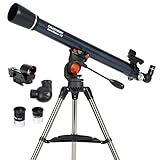
- POWERFUL TELESCOPE FOR BEGINNERS: The AstroMaster 70AZ is the perfect entry-level telescope for adults and kids eager to explore the night sky. You...
- HIGH-QUALITY 70MM OPTICS: Enjoy crisp, detailed views through the fully coated 70mm (2.8") achromatic refractor — perfect for observing the Moon...
- VERSATILE DAY & NIGHT USE: Designed for both astronomical and land-based viewing, the AstroMaster 70AZ lets you explore the stars at night and enjoy...
The New Horizons experiment provides the largest parallax baseline ever made — over 4 billion miles — and is the first demonstration of an easily observable stellar parallax,” said Tod Lauer, New Horizons science team member from the National Science Foundation’s National Optical-Infrared Astronomy Research Laboratory who coordinated the parallax demonstration.


