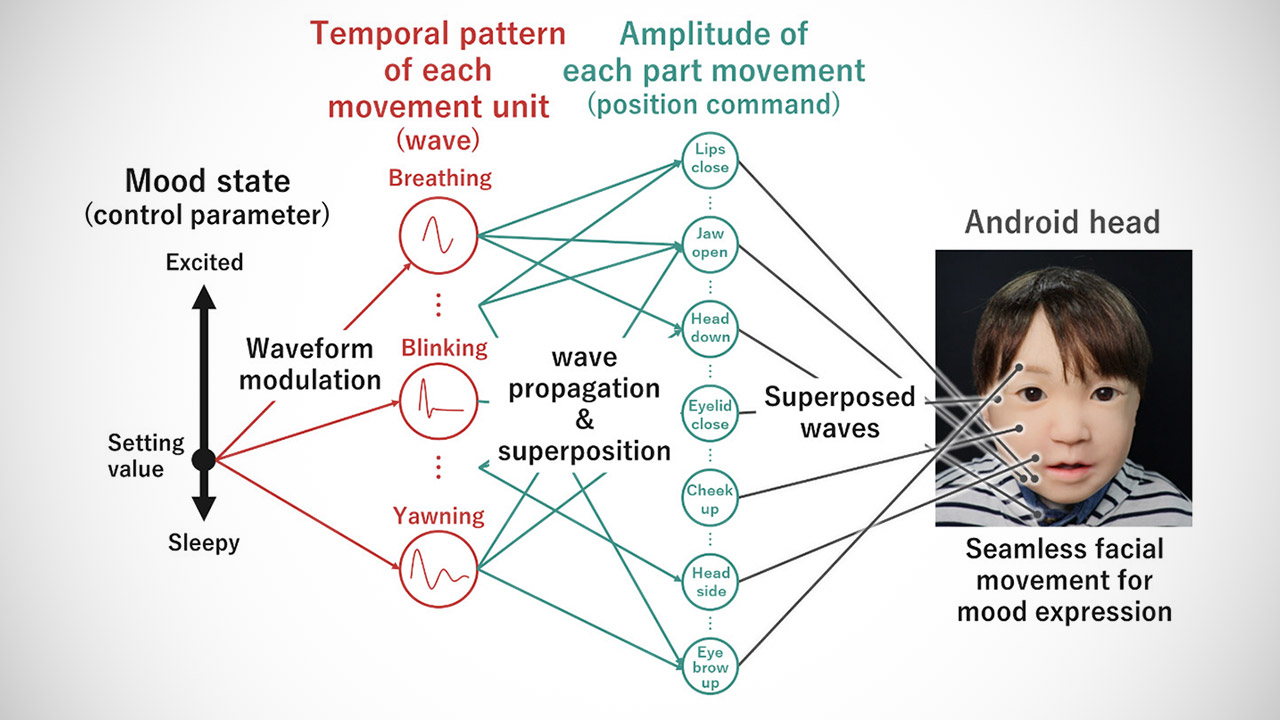
Osaka University researchers, led by Hisashi Ishihara, have developed a robotic child capable of demonstrating lifelike facial expressions, albeit somewhat sleepy ones. More specifically, the team worked on dynamic facial expression synthesis technology using “waveform movements,” which represents various gestures that constitute facial movements.
These facial movements include ‘breathing,’ ‘blinking,’ and ‘yawning,’ which are presented as individual waves propagated to the related facial areas. They are then overlaid on the robot to generate complex facial movements in real-time, thus eliminating the need for the preparation of complex and diverse action data while also avoiding noticeable movement transitions.
No products found.
Advancing this research in dynamic facial expression synthesis will enable robots capable of complex facial movements to exhibit more lively expressions and convey mood changes that respond to their surrounding circumstances, including interactions with humans. This could greatly enrich emotional communication between humans and robots,” said Koichi Osuka, senior author of the study.
[Source]