
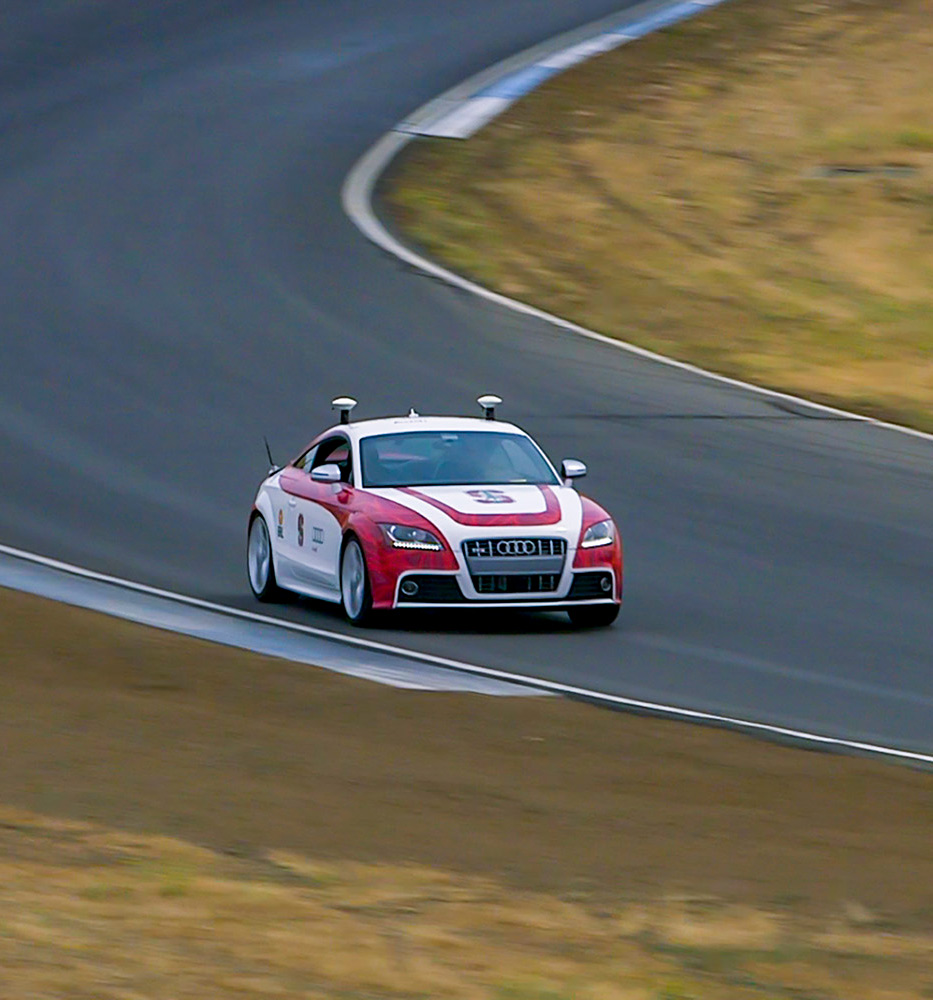

Photo credit: Kurt Hickman
Stanford researchers have developed an autonomous Audi TTS running new control software that relies on prior driving experience to remain in control, and be able to handle the unexpected. The team created a neural network to enable these driverless cars to perform high-speed maneuvers just like a pro driver.
The team basically trained a neural network with data from 200,000 motion samples, including test drives on slippery surfaces like snow / ice. They then took their system to Thunderhill Raceway in the Sacramento Valley to see how it would perform. The test consisted of two self-driving cars: Niki, an autonomous Volkswagen GTI, and Shelley, an autonomous Audi TTS.

- Audi toy car for kids – LEGO Speed Champions Audi S1 e-tron quattro Race Car model for boys and girls aged 9+ to collect, build, display and play...
- 1 minifigure – The LEGO car includes a removable roof and a driver minifigure with a helmet, wig and a wrench for kids to place behind the wheel and...
- Authentic Audi design details – The Audi S1 e-tron quattro Race Car replica features a towering rear wing, deep rear diffuser, front splitter and...
Our work is motivated by safety, and we want autonomous vehicles to work in many scenarios, from normal driving on high-friction asphalt to fast, low-friction driving in ice and snow. We want our algorithms to be as good as the best skilled drivers – and, hopefully, better,” said Nathan Spielberg, a graduate student in mechanical engineering at Stanford.

