Photo credit: Jake Socha
Flying snakes, like the paradise tree snake, can be found residing in the trees of South and Southeast Asia. They slither from tree branches, but to get to the ground or another tree, they’ll catapult themselves into the air and glide down at an angle. To figure out how they glide, researchers placed motion-capture tags on seven snakes and then used high-speed cameras to film them as they glided across a giant four-story-high theater.
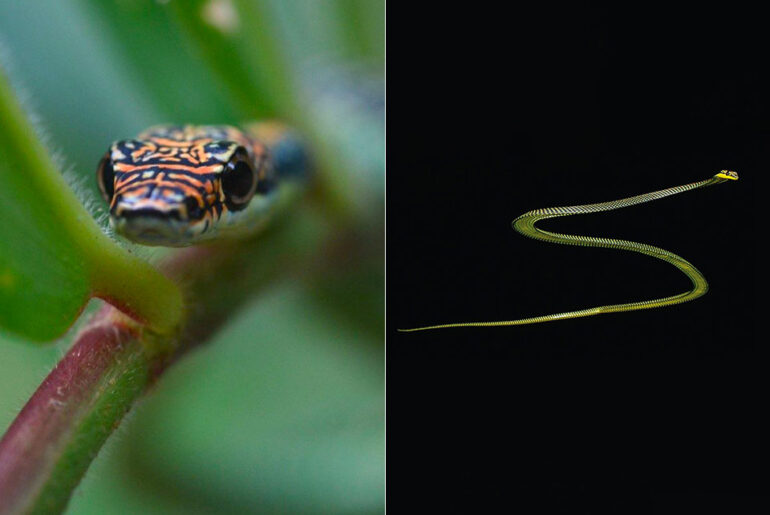
Photo credit: Alireza Zamani | University of Turku via DailyMail
Scientists have discovered a new velvet spider species that wears a vibrant red-and-white pattern on its back reminiscent of the grin worn by Joaquin Phoenix, who played the Joker, Batman’s long-standing nemesis. It’s officially called “Loureedia phoenixi”, and it’s the first Loureedia spider to be identified outside the Mediterranean region. Read more for additional pictures and information.

Georgia Tech researchers have deployed a hyper-efficient SlothBot at the Atlanta Botanical Garden. This robotic sloth is powered by pair of photovoltaic panels and designed to hang in the forest canopy continuously for months. It only moves when it must to measure environmental changes, like weather, animal movement and chemical factors. Read more for a video and additional information.

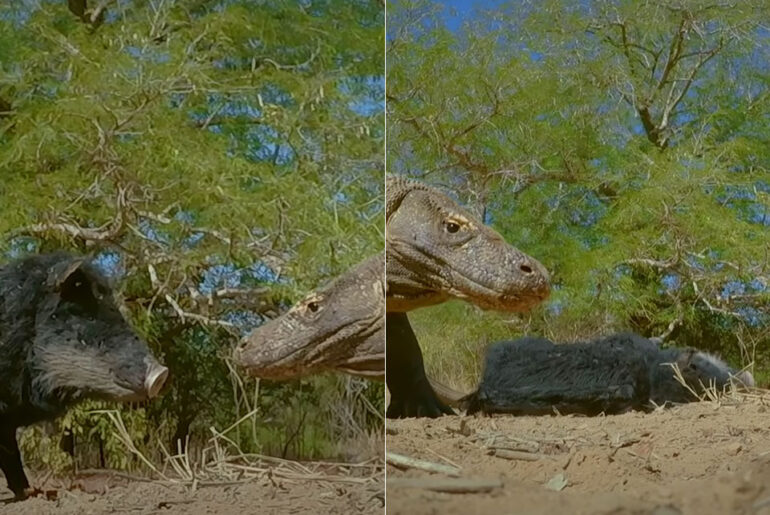
A small robotic spy pig was unfortunately destroyed by komodo dragons while filming for a BBC wildlife documentary. This robot was approached by male Komodo dragons on the hunt for female mates on Komodo Island in Indonesia. Not sure what this thing actually was, the territorial reptiles started to tear the spy pig apart.

Before becoming a YouTube sensation, Mark Rober worked at NASA’s Jet Propulsion Laboratory (JPL) for around nine years, seven of which were spent working on the Curiosity rover, which is now on Mars. He was one of the main architects for “JPL Wired”, and even published a case study about applying wiki technology in a high-tech organization to develop an “Intrapedia” for the capture of corporate knowledge.

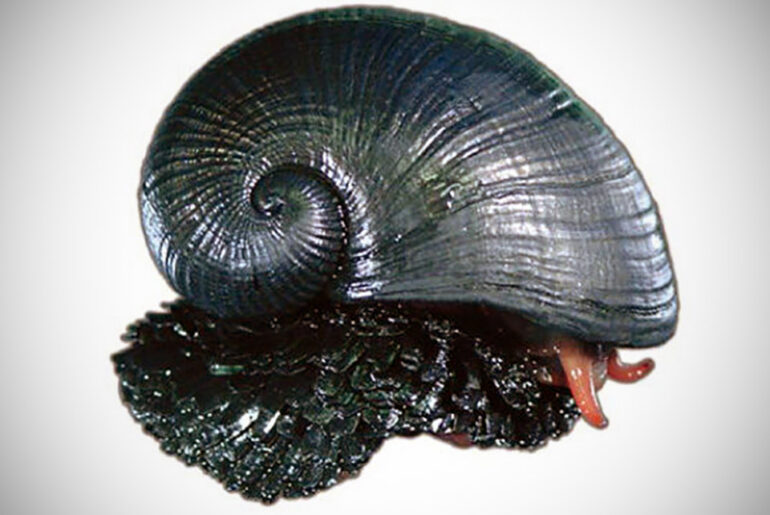
The bizarre-looking deep sea snail boasts a unique three-layered shell that can easily fend off attacks from crabs as well as protect it from high temperatures. They’re currently known to exist around four hydrothermal vents in the Indian Ocean where temperatures can reach up to 750 degrees Fahrenheit. Its outer layer of its shell is made from iron sulfide, creating a suit of armor around its vitals.

Researchers, inspired by the biomechanics of cheetahs, have invented a new type of soft robotics capable of moving more quickly than previous generations on solid surfaces or in the water. Previous soft robots could move at 0.8 body lengths per second on flat, solid surfaces, but this new class of soft robots, which are called “Leveraging Elastic instabilities for Amplified Performance” (LEAP), are able to reach speeds of up to 2.7 body lengths per second at a low actuation frequency of 3Hz. Read more for a video and additional information.

On PBS’s Spy in the Wild 2 – Episode Two: The North, a spy camera disguised as a macaque join a group of primates in the Jigokudani Monkey Park. These monkeys begin most days with a relaxing dip in Joshinetsu Kogen National Park in Japan’s Nagano prefecture. This primate-only onsen is world-famous as the preferred simian hot spring.

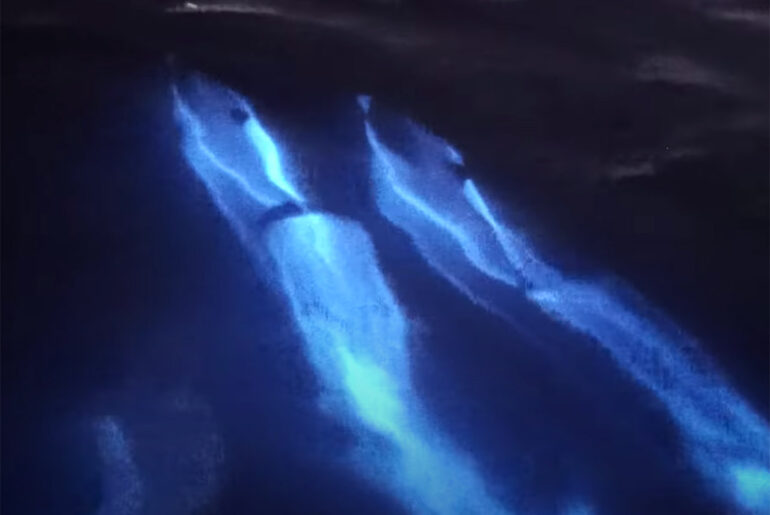
With a red tide here to say in Southern California’s coastline, there’s a regularly occurring nightly display of bioluminescence, but this past Thursday might have been the greatest show yet. A photographer managed to capture a pod of neon blue dolphins gliding through the tide in Newport Beach. These creatures were swimming alongside crews with Newport Coastal Adventure, a whale watching company in Newport Beach.

Schmidt Ocean Institute scientists have discovered an bizarre creature off the eastern Indian Ocean in the remote western coast of Australia. The scientific name for this organism is Apolemia, or a type of siphonophore in the deep-sea environment known as the Ningaloo Canyons. It preys on tiny crustacean and fish using its array of stinging cells on their tentacles. Read more for a video and additional information.