
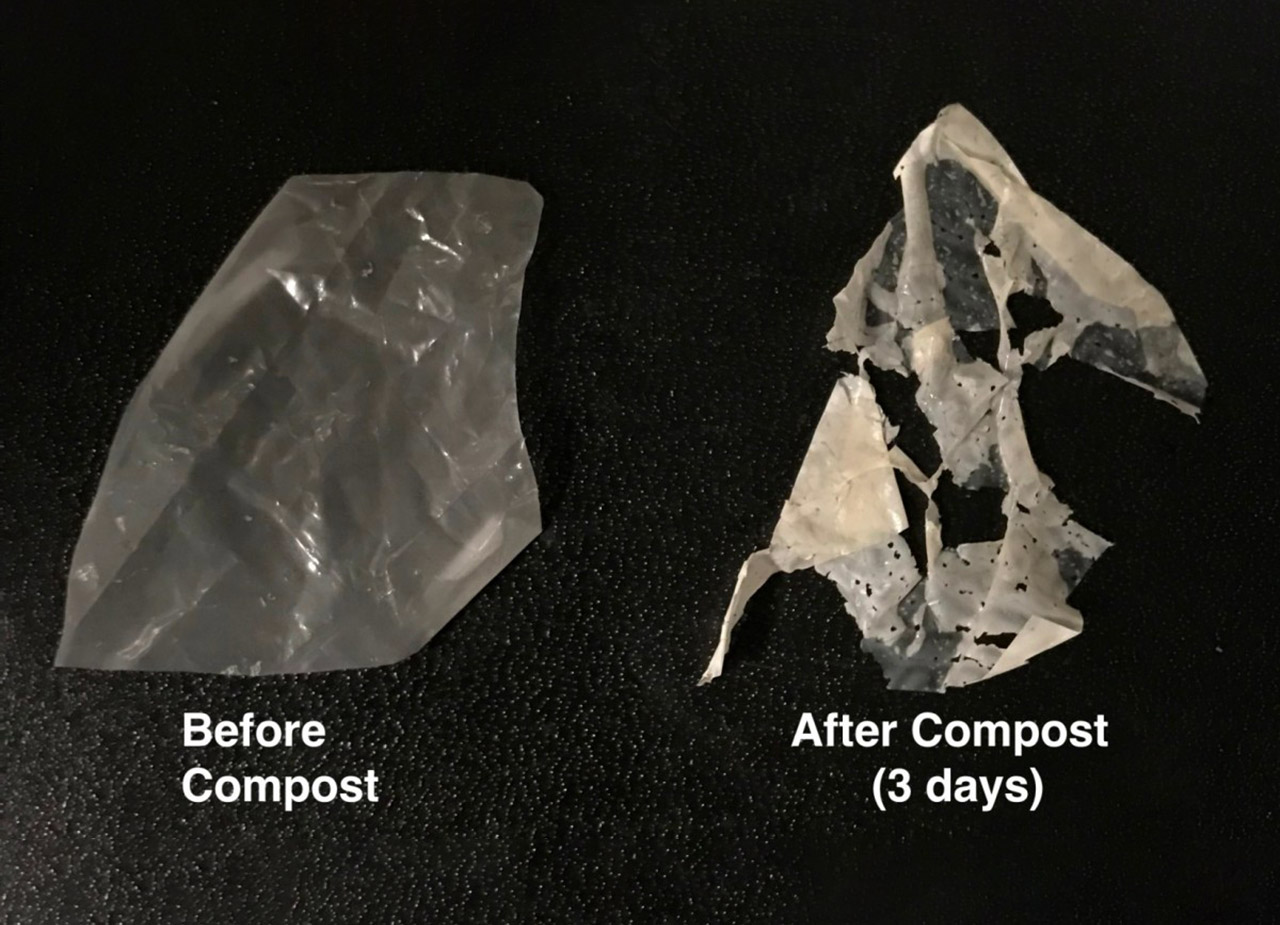
The U.S. Army is collaborating with researchers at University of California, Berkeley and the University of Massachusetts Amherst, to develop a truly compostable biodegradable plastic by embedding polyester-eating enzymes as it’s made. When this enzyme is exposed to heat as well as water, it sheds its polymer shroud and starts eating the plastic polymer into its building blocks. In the case of biodegradable plastics, which consist primarily of the polyester known as polylactic acid (PLA), it reduces it to lactic acid that can feed the soil microbes in compost. Read more for a video and additional information.
This process aims to eliminate microplastics, a byproduct of many chemical degradation processes and a pollutant, as up to 98% of the plastic made using this new technique degrades into small molecules. Other practical uses for this technique include being used in damaged equipment or vehicle parts that can be degraded and then re-made in the field, or repurposed for a totally different purpose.
- Self-developed Silent Motherboard: The Ender-3 V2 built-in self-developed silent motherboard, which has stronger anti-interference, faster and more...
- UL Certified Branded Power Supply: Equipped with branded power supply, produced by the listed company with mature technology, meeting all the needs of...
- Effortless Filament Feed-in: Ender-3 V2 adds a rotary knob on the extruder, making loading and feeding filament process much easier; Brand new...

These results provide a foundation for the rational design of polymeric materials that could degrade over relatively short timescales, which could provide significant advantages for Army logistics related to waste management. More broadly, these results provide insight into strategies for the incorporation of active biomolecules into solid-state materials, which could have implications for a variety of future Army capabilities including sensing, decontamination, and self-healing materials,” said Dr. Stephanie McElhinny, program manager, Army Research Office, an element of the U.S. Army Combat Capabilities Development Command, known as DEVCOM, Army Research Laboratory.
