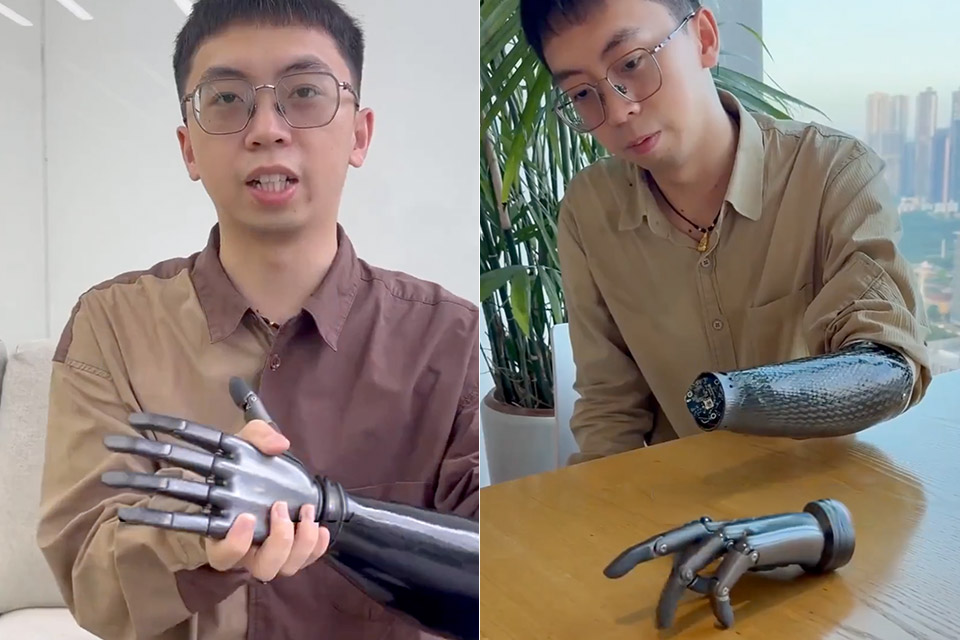
Users who have lost a hand can now move individual fingers on BrainCo’s prosthetic by reading a mix of signals that still travel through the remaining arm. Sensors in a simple cuff against the skin detect the electrical activity that muscles produce when a person tries to move, along with the weaker neural impulses that accompany those intentions. Software then converts the combined readings into separate commands for each finger, with a lag of about 0.38 seconds and positioning accuracy down to a tenth of a degree.
A young Chinese neurotechnology company wiped out U.S. smart prosthetic firms that had boasted about their "advanced prosthetics" for years.
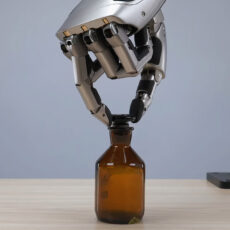
BrainCo’s bionic hand weighs just 383 grams, delivers more than 50N of grip force, interprets neural and muscle signals, and lets users grasp, type, drink, exercise and control the hand almost intuitively.
Western companies made smart prosthetics look like futuristic luxury hardware.
China is turning them into something lighter, stronger, more practical and increasingly manufacturable.The real disruption is not that China made a better demo.
It is that China is industrializing what others kept presenting as the future.America marketed the future.
China put it on an arm.— 𝘊𝘰𝘳𝘳𝘪𝘯𝘦 (@OopsGuess) October 14, 2026
That setup enables users to perform tasks that formerly required constant eyeballing or the flipping of several physical switches. Amputees have been able to type emails on their keyboards, unscrew bottle lids, move boxes off the ground, practice calligraphy with a brush, and even perform brief piano pieces to crowded crowds. One user claims their hand has just come back to life after all these years, and he was brave enough to try rock climbing.

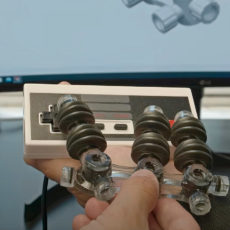
- Build your own awesome, wearable mechanical hand that you operate with your own fingers.
- No motors, no batteries — just the power of air pressure, water, and your own hands!
- Hydraulic pistons enable the mechanical fingers to open and close and grip objects with enough force to lift them. Every finger joint can be adjusted...
The hand itself weighs only 383 grams, making it comfortable to wear all day. It also has a grip force of 50 newtons, which is rather astounding. The balance between being extremely lightweight and sturdy enough to withstand big loads is critical. It just takes about a minute to put it on, and charging is as simple as plugging it into a USB-C connection; no extra equipment is required. Fortunately, the sensors do not need to be implanted, thus there is no need for surgery.
BrainCo started all of this after one of their own employees lost a hand. Based in the United States near Harvard and subsequently on the other side of the world in Hangzhou, China, the company chose non-invasive technology from the start so that it could serve a far larger number of people without the high expense and hazards of implants. Each new version improved the electrode placement and algorithms until they reached a point where independent finger control was suitable for mass production, resulting in the first prosthetic of this type on the market at this scale and with this level of single finger response.
The same decoding algorithms discussed here are now being employed in BrainCo’s robotic hands, which are designed to interact with humanoid robots. These versions include more joints and sensors and are employed in labs and industries, but the core technology remains the same: collecting body signals and translating them into coordinated action. People are taking note because it indicates we’ve progressed from only being able to demonstrate the technology on stage to being able to get your hands on it and utilize it in your daily activities.