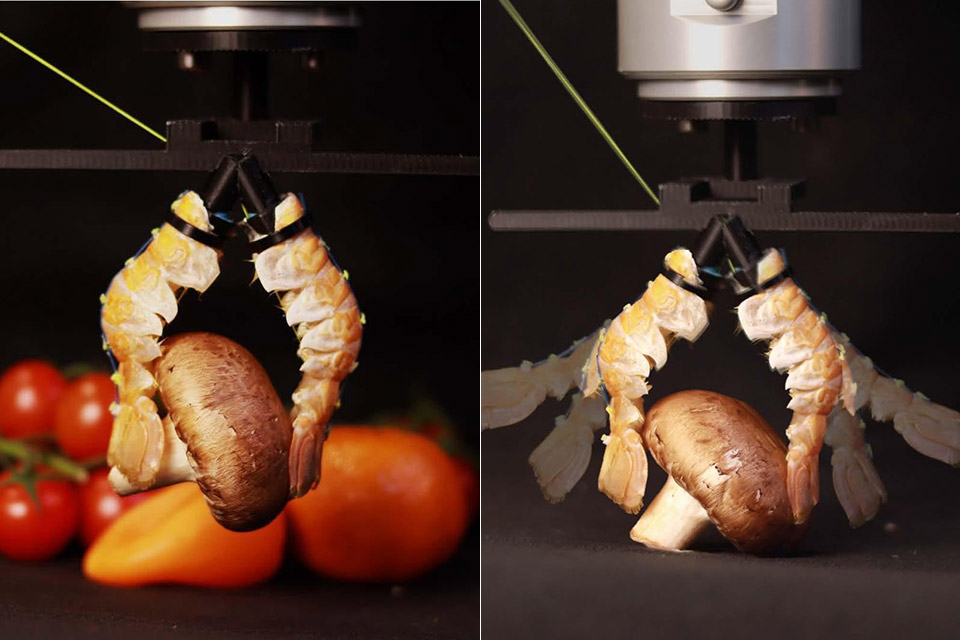
Photo credit: 2025 CREATE Lab EPFL CC BY SA
In a small quiet lab tucked away in the Swiss countryside, a team of engineers has figured out a method to repurpose discarded langostino lobster shells into grippers that can pick up pens or tomatoes with amazing ease. These aren’t the conventional metal claws you see attached onto assembly lines; instead, they employ the leftovers from seafood dinners, combining biology’s trash with a few basic mechanical adjustments to make tools that bend and hold like something very much alive.
Josie Hughes oversees the CREATE Lab at EPFL, and she has a team that includes principal researcher Sareum Kim and a few others, such as K. Gilday; they began with large piles of langoustine shells, the curly things that people frequently dump in the trash after a seafood banquet. Each one is a natural wonder: a segmented tube made of chitin, an extremely hard protein, and minerals that give it strength. Then you have those thin, flexible membranes at the joints that allow it to bend without breaking. The team realized that this configuration was essentially a natural, pre-made framework that already understands how to curl and uncurl without snapping. So they combined these shells with some fairly standard synthetics: a soft type of rubber called elastic that they slip inside to help control how each of the segments bends, a small motor at the bottom to power the bends, and a layer of silicone on the outside to protect and extend its life.

- Assemble a cutting-edge, working toy robotic arm from nearly 300 pieces!
- No motors or electricity required! The innovative system is controlled by a pair of joysticks that pull and release a network of nylon cables to...
- The buttons on the top of the joysticks open, close, and rotate the arm and the claw that attaches to the end of it; challenge yourself or friends to...
Building one begins with the team simply filling the inside of the shell with elastomer, allowing them to control how each of the five or six parts responds to being tugged or pushed. Once that’s done, you simply bolt it to the motorized base, and the entire thing can learn to straighten out or curl into a hook using basic actuator parts from a hobby kit. Once covered in silicone to seal it in, you’ll have a gripper that can pick up objects. When two of these are placed side by side like a pair of hands, something magical happens. You have a gripper that can shut its hands over items; the beauty is in how the shell’s innate idiosyncrasies show through: no two langoustines bend the same way, so each gripper picks up its own distinct curve and style, but the pieces added by the team ensure it closes every time.
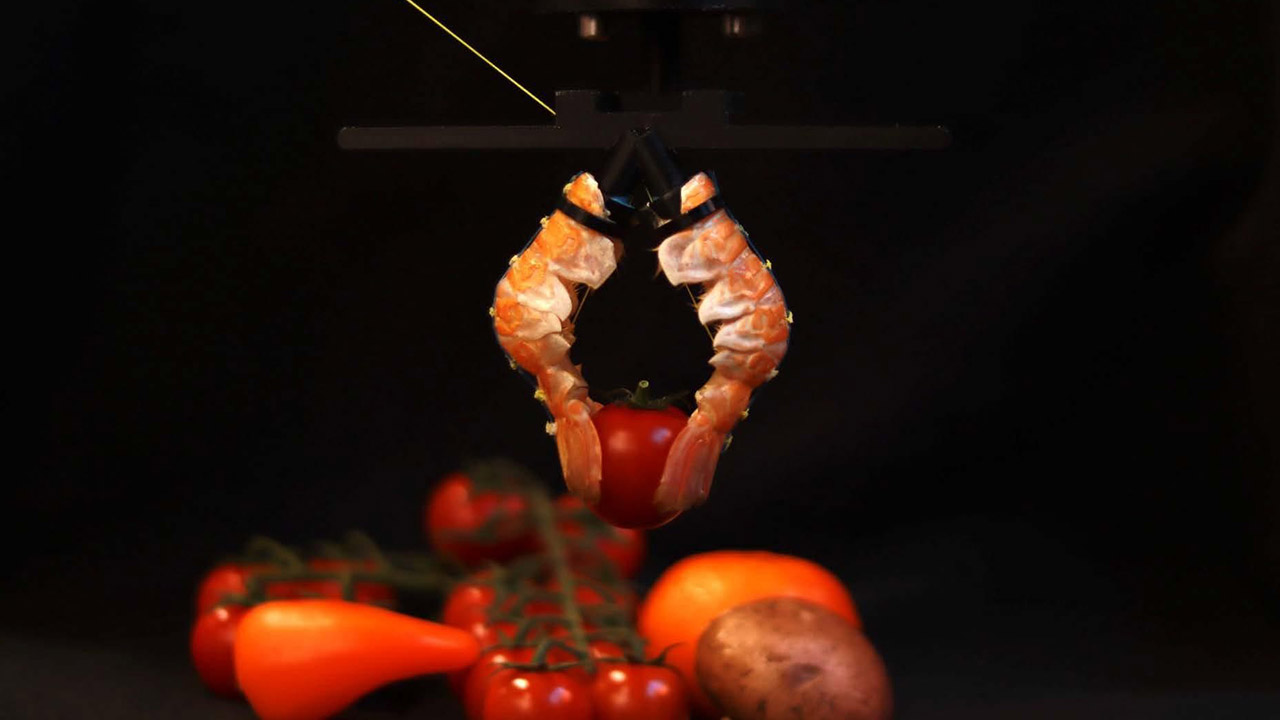
Watch one of these in motion, and the movement appears nearly lifelike. Turn on the motor, and the base begins to tug on the elastomer, sending small ripples through the segments one by one. The first joint may dip down gently, the next more abruptly, and finally the points meet and clamp down tightly enough to hold a highlighter pen in place without squishing it. Instead, insert a ripe tomato, which is softer and squarer, and the grip adapts on the fly, with flexible membranes soaking up the give and hard portions locking the object in place. In testing, these grippers worked well with everything from long narrow tools to enormous bulky fruit, and they could adjust to shapes that a stiff plastic gripper would struggle with. One model even reached up to an arm, lifting a load of up to 500 grams and depositing it neatly into a container, all while the shell remained strong under strain.
However, these shells are also excellent for propulsion. The scientists mounted them as flappy fins on an underwater bot, and the segments whipping back and forth propelled the thing at a good clip, 11 centimeters per second. The water streaming past the joints was no great concern, and the flexible portions helped prevent the painful snaps that come with rigid propellers. Hughes points out that this is essentially how crustaceans do it in the wild, with shrimp and their kin darting across the water on their flexible abdomens. If you can replicate that, you can get a lot more efficiency out of your design, and her group’s synthetic equivalents picked it up right away, saving them years of trial and error.
[Source]