
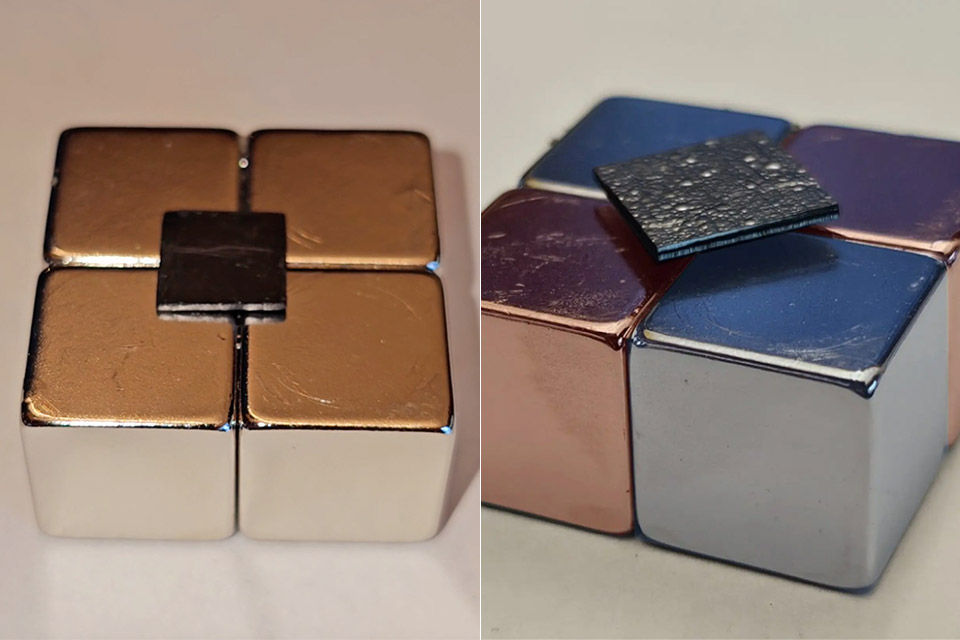
Scientists from the Okinawa Institute of Science and Technology (OIST) have created a floating platform within a vacuum using graphite and magnets that requires no external power source. Should that platform encounter an external magnetic field, these materials generate a magnetic field in the opposite direction, resulting in a repulsive force.
Graphite is essentially the crystalline form of carbon found in pencils and is strongly repelled by magnets (highly diamagnetic). By chemically coating a powder of microscopic graphite beads with silica and mixing the coated powder in wax, the team created a centimeter-sized thin square plate capable of hovering above magnets arranged in a grid pattern. What does all of this mean for the future? This new material paves the path for potentially unlocking gravity-free technology.

- USEFUL TOOL MAGNETS: Mini rectangular magnets can be used for tool storage, as whiteboard magnets, for DIY projects, as refrigerator magnets, on...
- CLASSROOM USE These 60x10x3mm magnets Built for basic physics demos, these ceramic magnets help students explore magnetism, force and measurement...
- PREMIUM COATING: Ni+Cu+Ni Coated. Our strong magnets provide rust resistant protection. Each of rare earth magnets strips has a smooth surface, which...

If cooled sufficiently, our levitating platform could outperform even the most sensitive atomic gravimeters developed to date. These are cutting-edge instruments that use the behavior of atoms to precisely measure gravity. Achieving this level of precision requires rigorous engineering to isolate the platform from external disturbances such as vibrations, magnetic fields, and electrical noise. Our ongoing work focuses on refining these systems to unlock the full potential of this technology,” said Prof. Jason Twamley, head of Quantum Machines Unit at OIST.


