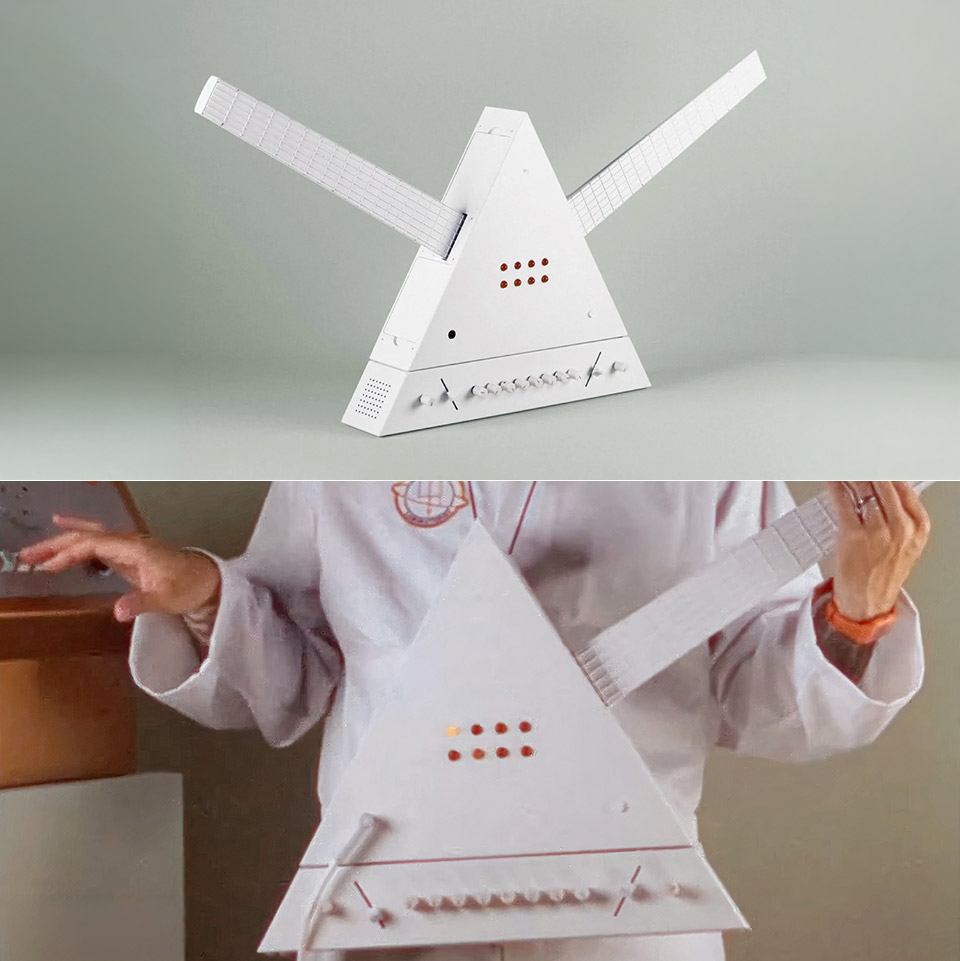
Swedish designer Love Hultén accepted a private commission with an unusual request. Turn the flat triangle from Pink Floyd’s most famous album cover into a guitar that someone can actually pick up and play. Hultén already held a reputation for instruments that borrow strong visual references and then make them functional. Past projects include synthesizers shaped like Darth Vader helmets, compact keyboards styled after old game hardware, and other pieces that treat electronics as three-dimensional objects rather than hidden components. The new instrument, called the Magicos-2, continues that pattern while answering a direct challenge: keep the prism shape intact and still deliver real musical response.
The finished piece is about the size of a compact double neck, but it has a rigorous geometric design. It’s based on an equilateral triangle with clean white planes. The triangle features two arms extending out to either side, each with a full grid of frets running the length of the arm, providing a playing surface that connects to the electronics within rather than traditional vibrating strings.

- WHY CARBON FIBER - Nova Go SP1 is made of carbon fiber composite material, which means it's impervious to temperature and humidity change. Taking it...
- WHERE THINGS GET INTERESTING - The absolute differentiator of this guitar is that it’s equipped with the SP1 pickup system. It gets you reverb...
- A PRODUCTIVITY WORKHORSE - SP1 pickup system not only allows you to have tons of fun unplugged. But if you plug it into an amp or PA, this Nova Go SP...
Nine amber teardrop controls sit along one side of the triangle, with rounded edges and a warm glow that suggests easy access to the primary settings. It combines a control panel with a graphic design. A trapezoidal base rests beneath the triangle, supporting it from underneath, as this section of the sculpture is readily detached from the remainder via a seam. The primary effects chain is next, followed by a little rose quartz pyramid nested within the base. Its internal lighting gives the crystal a soft glow from the inside out, which Hultén refers to as the crystalline emitter.

Each arm has its own sound source, with the left arm having a 1010music Tangerine module and the right arm having a 1010music Lemondrop module, both of which can produce an individual synthesis sound with its own character and configurable settings. Players can trigger notes from the fret grids on the arms, and one engine can produce a sustained string-like tone while the other creates changing drones or pads.
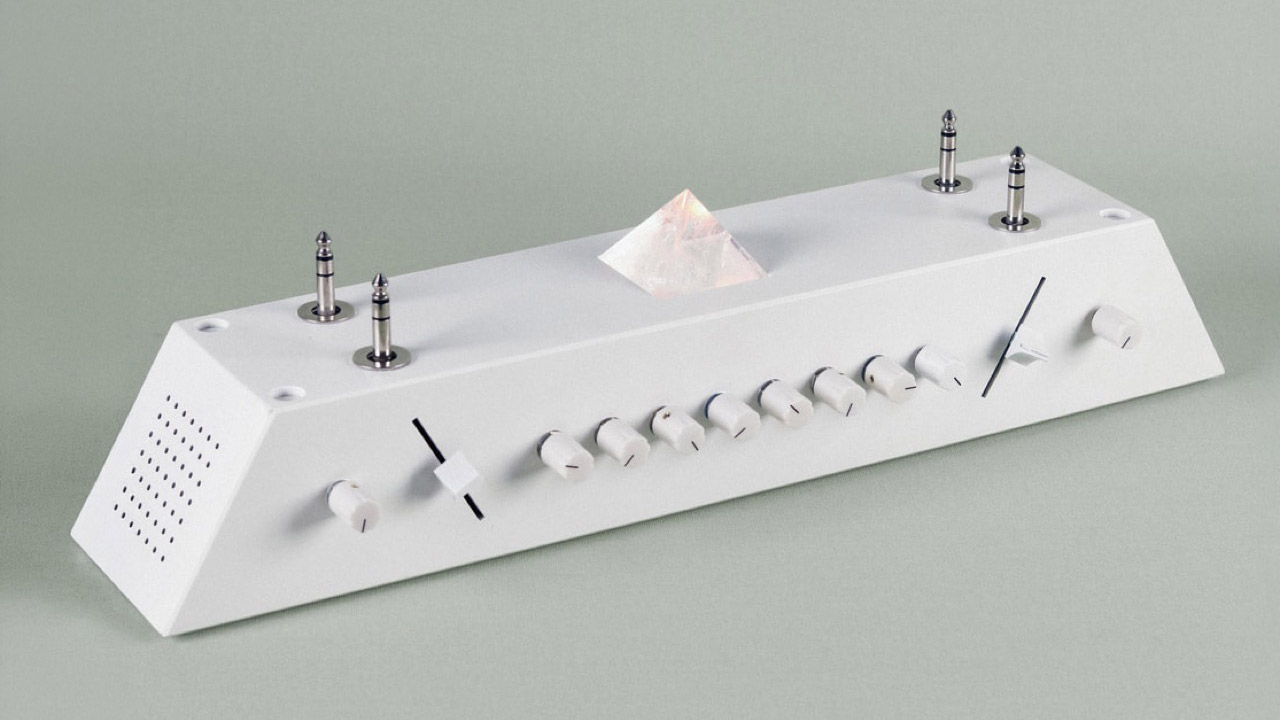
The signals from the arms are then routed to the detachable base, where a Walrus Audio Lore unit provides beautiful reverse reverb and lengthy, atmospheric tails. Then a Collision Devices TARs unit appears, introducing some fuzz and denser harmonics. These two effects combine the two distinct voices to create thicker, moving layers without having the user to make frequent modifications on the fly, as the synthesis engines remain independent until they reach the shared effects area.
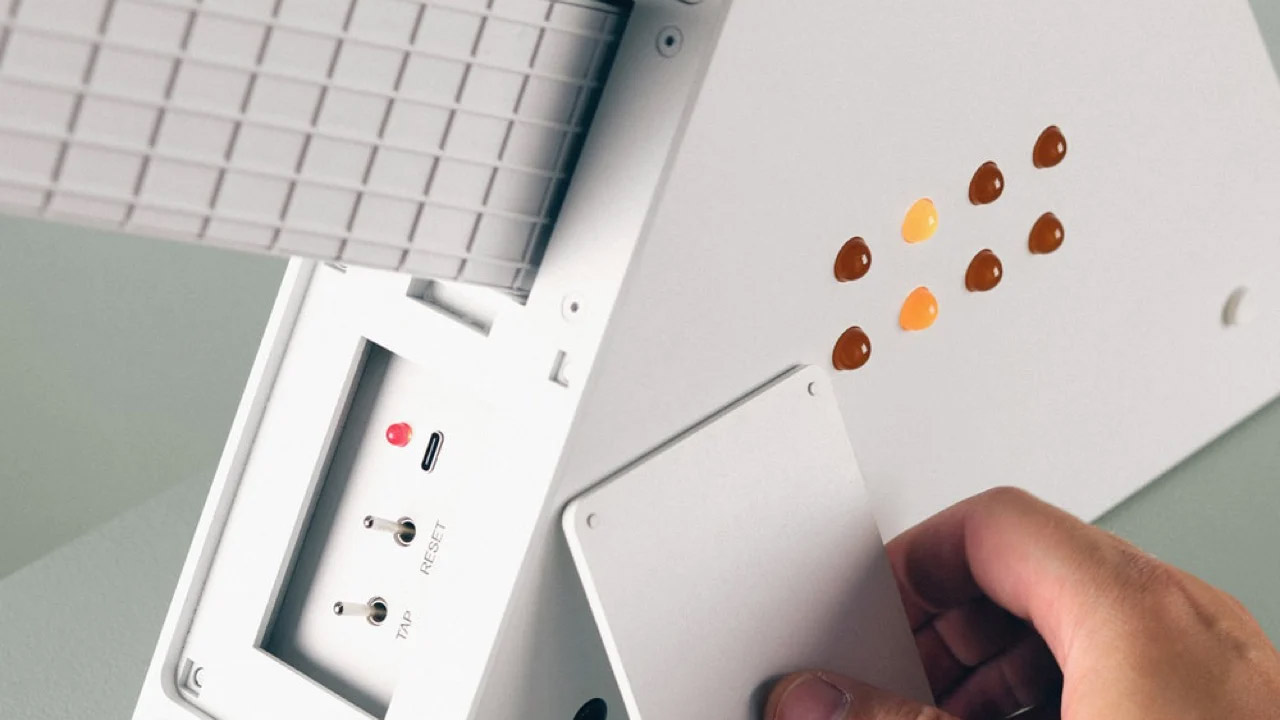
The player can use one arm to carry melodic passages and the other to maintain a consistent tonal basis. The effects then kick in, blending the two streams together to create prolonged washes and overlapping textures that move and alter as the player adjusts the parameters. The removable base is ideal for everyday use because it allows you to pull it off and reattach it as needed, decreasing the size for transport, and allowing you to reach in and service the effects or reroute the signal path without affecting the main piece. Reconnecting is accomplished through a simple and snug joint that keeps everything in alignment.
[Source]