
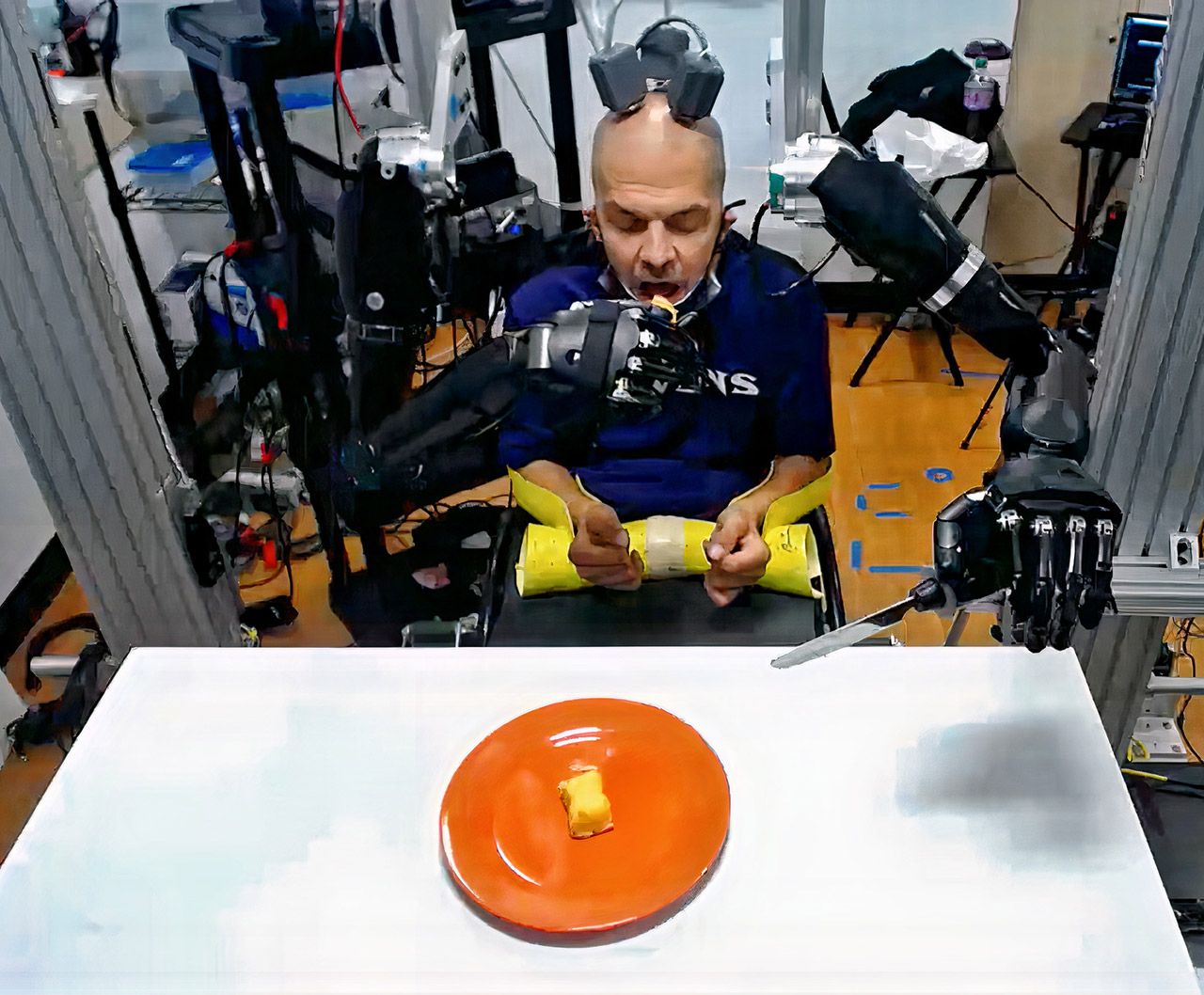

Robert “Buz” Chmielewski has been a quadriplegic with minimal movement and feeling in his hands and fingers due to an accident in his teen years, but starting a few months ago, he was able to manipulate two prosthetic arms with his brain. This was made possibly after surgeons implanted six electrode arrays into both sides of his brain, enabling him to simultaneously control two advanced prosthetic limbs through a brain-machine interface developed by Johns Hopkins Applied Physics Laboratory (APL).
Researchers are currently devleoping a closed-loop system that merges artificial intelligence, robotics and a brain-machine interface. Now that you’ve seen Chmielewski feed himself dessert, the system that enabled him to control the movements necessary to cut food with a fork and knife and feed himself, could eventually help him walk again.
No products found.
Our ultimate goal is to make activities such as eating easy to accomplish, having the robot do one part of the work and leaving the user, in this case Buz, in charge of the details: which food to eat, where to cut, how big the cut piece should be. By combining brain-computer interface signals with robotics and artificial intelligence, we allow the human to focus on the parts of the task that matter most,” said David Handelman, an APL senior roboticist specializing in human-machine teaming.


