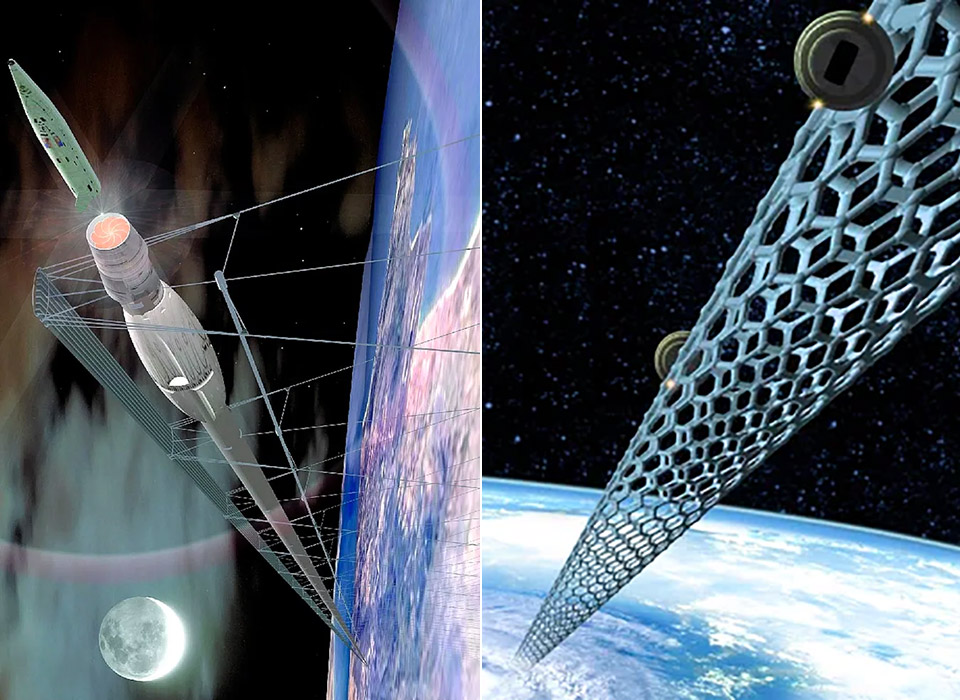

There’s the SkyPod, and then space elevators that have been featured in many science fiction works. McGill University professor Arun Misra believes this technology could go from science fiction to reality within the next 20 to 30 years. Once built, this would allow you to release a payload in the lower portion, while orbiting Earth in the upper portion, all without fuel.
One concept consists of a 62,000 mile cable 50-times stronger than stell that extends upwards into the sky from the Earth’s equator, attached to a satellite in a geosynchronous orbit. This would make use of mechanical climbers tasked with reaching different altitudes from Earth’s surface to either release a capsule or spacecraft. Both would then start orbiting the Earth, Sun or simply fall back to Earth.

- BUILD AN OFFICIAL NASA ROCKET – Kids prepare to explore outer space with the LEGO Technic NASA Artemis Space Launch System Rocket (42221) building...
- 3-STAGE ROCKET SEPARATION – Young builders can turn the hand crank to watch the rocket separate in 3 distinct stages: solid rocket boosters, core...
- STEM BUILDING TOY FOR KIDS – This educational rocket kit was created in collaboration with NASA and ESA to showcase the authentic system that will...
Imagine a 100,000-kilometer-long cable that extends up from Earth’s equator and is fixed to a satellite at the far end. The system spins along with the Earth. Climbers can scale the cable transporting payloads and then releasing them in space. I was thinking you might study the dynamics of this system,” said Arun Misra, Professor in the Mechanical Engineering Department at McGill University.