Photo credit: EADS Astrium
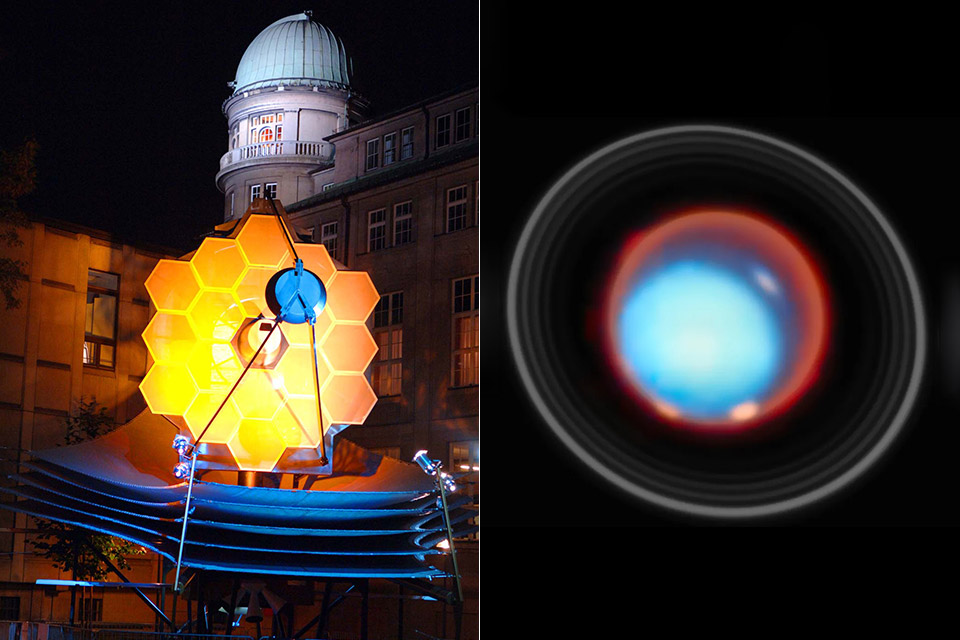
NASA’s James Webb Space Telescope delivers the first 3D map of Uranus’ aurorae, providing a spectacular view into the planet’s upper atmosphere at previously unheard-of clarity. This was accomplished by a team led by PhD student Paola Tiranti of Northumbria University.
On January 19, 2025, astronomers used the JWST’s Near-Infrared Spectrograph to observe Uranus for 15 hours, providing a complete picture of the planet as it nearly fully turned. The Integral Field Unit of the Near-Infrared Spectrograph was able to detect very faint signals from molecules in the upper atmosphere, up to nearly 5,000 kilometers above the planet’s visible clouds. What was picking up these tiny signals was the ionosphere, which is where charged particles from the solar wind mix with the planet’s atmosphere.

- BUILD AN OFFICIAL NASA ROCKET – Kids prepare to explore outer space with the LEGO Technic NASA Artemis Space Launch System Rocket (42221) building...
- 3-STAGE ROCKET SEPARATION – Young builders can turn the hand crank to watch the rocket separate in 3 distinct stages: solid rocket boosters, core...
- STEM BUILDING TOY FOR KIDS – This educational rocket kit was created in collaboration with NASA and ESA to showcase the authentic system that will...
One of the things that makes Uranus unique compared to the other planets in our solar system is that its magnetic field is actually tilted at a weird angle of about 60 degrees from the planet’s axis of rotation. This only creates a complicated set of patterns for the auroras to follow as the globe rotates. The most recent observations show two enormous auroral bands near the magnetic poles, with a wide gap in between characterized by lower ion density and emission, probably due to the configuration of the magnetic field lines.
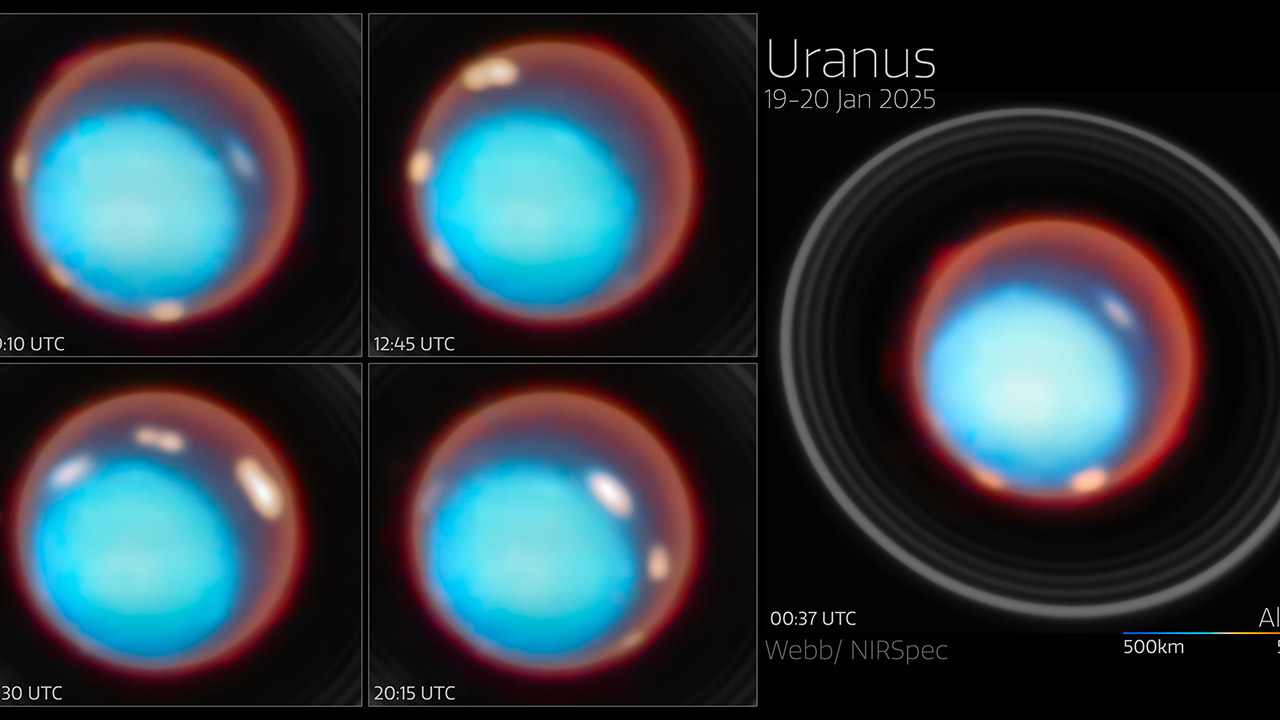
The upper atmosphere of Uranus is quite hot, averaging around 150 degrees Celsius, with temperatures peaking between 3 and 4 thousand kilometers above. Then there’s ion density, which is at its peak around 1,000 kilometers above. Evidence suggests that the upper atmosphere has been cooling since the early 1990s, first observed when Voyager 2 flew by the planet in 1986, but we can now measure it much more precisely.
Previously, scientists have seen a few glimpses of the auroras on Uranus using Hubble and ground-based telescopes, but only in visible as well as ultraviolet light. JWST can sense infrared, enabling the scientists to create a three-dimensional image of the upper atmosphere, following how energy moves upward from auroral activity.
Looking at the map they got, you can see a lot of variance in the longitude, which is directly related to the magnetic field being all goofy. This results in these patterns because particles follow the magnetic field lines and deposit heat and ions in very specific locations. That all has a meaningful impact on the planet’s energy balance, which impacts atmospheric circulation far beyond the cloud tops.