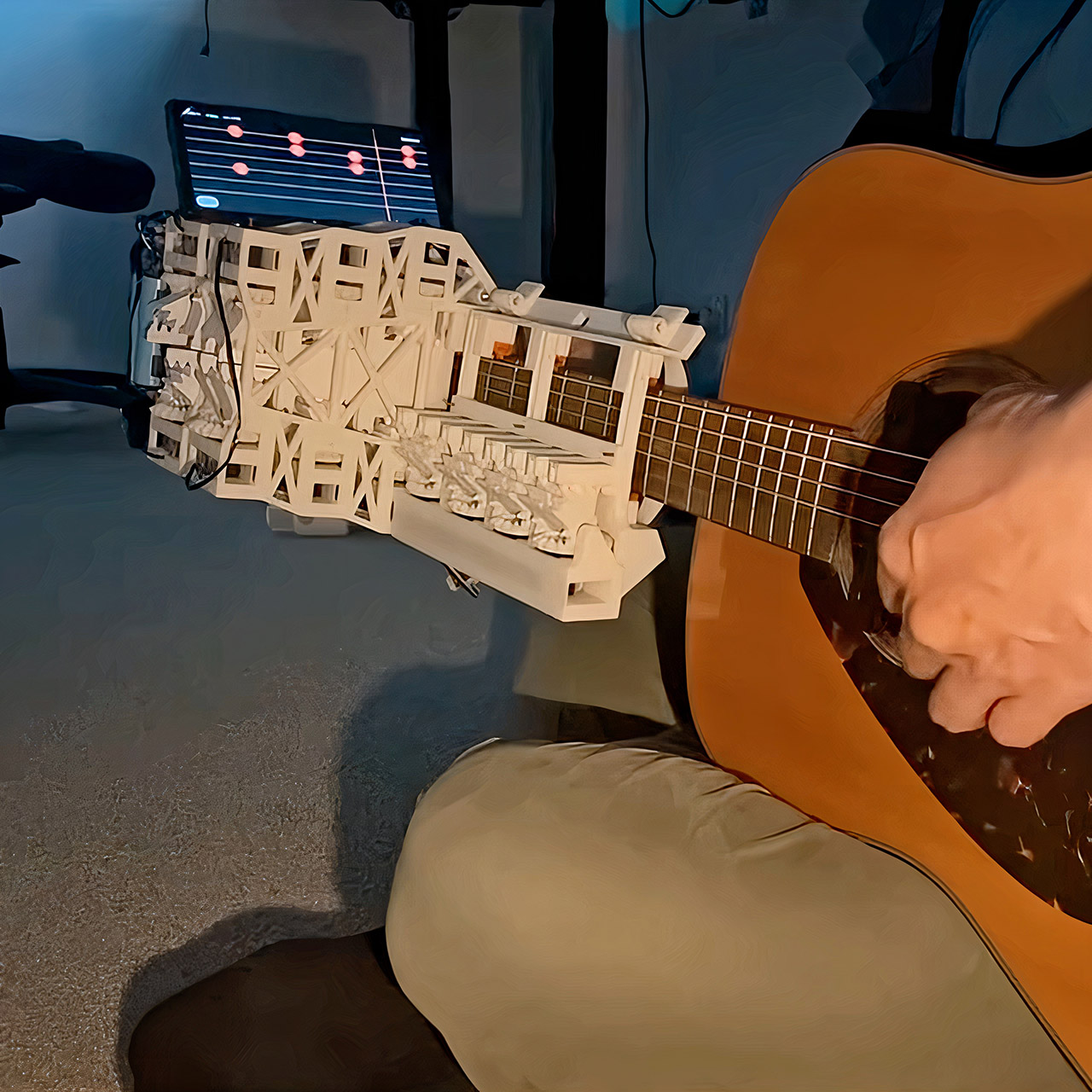
After long evenings spent designing mechanisms and calibrating movement, a New Zealand engineer named Bruce finished a system that mounts directly onto an ordinary acoustic guitar and turns digital tablature into live string vibration. He calls it MegCell Pulse. Two coordinated robots handle the work of human hands. One presses the strings against the frets. The other plucks them with six individual plectrums. The sound that reaches the room is the actual instrument speaking, complete with the body resonance and the space around it.
Bruce began this project as an engineer rather than a musician, drawing on his skills in naval engineering, composite work, CAD drawings, and automation. In spare hours after his day job he kept asking what would happen if digital music instructions could drive a real guitar instead of a speaker. He spent roughly 6 or 7 years tinkering with the concept and its variants. The majority of the build is completed on a normal 3D printer, with the remaining parts sourced from a basic list that anybody can order. The software translates ordinary digital tablature into a precise timing signal for the actuators, and it does so without requiring special programming for each song.
- WHY CARBON FIBER - Nova Go SP1 is made of carbon fiber composite material, which means it's impervious to temperature and humidity change. Taking it...
- WHERE THINGS GET INTERESTING - The absolute differentiator of this guitar is that it’s equipped with the SP1 pickup system. It gets you reverb...
- A PRODUCTIVITY WORKHORSE - SP1 pickup system not only allows you to have tons of fun unplugged. But if you plug it into an amp or PA, this Nova Go SP...
After you put the frames onto the guitar, some gears and magnetic actuators begin moving the arms, which is quite cool. The fretting side simply presses each string in the proper location between the frets, while the plucking side strikes individual strings in sequence or all at once, depending on the file you imported. Timing remains fixed to the digital instructions, ensuring consistent performance from one run to the next. All the user has to do is load a tab file and hit play: the robots will do the rest, while the wooden body and strings generate the tone.
One of the most practical applications allows a human to handle only the plucking, leaving the fretting to the machine. A single-handed musician may complete a full arrangement this way, as Bruce has demonstrated in a video where the robot supplies the left-hand section while a person handles the right, which feels rather natural.
There are a few things it can’t do currently, such as not covering the entire fretboard or doing that nice sliding between frets for legato lines, but the limitations are real, and it still covers a large range of pieces if they are first available as digital tablature. The method focuses on accuracy and consistency rather than trying to record every single human flourish, which keeps the performances sounding rather clean.
No finished units are shipped from the factory, but Kickstarter backers receive the complete digital product, which includes STL files for the printed pieces, a detailed assembly guide, control software, and a parts list. The top tier was one hundred dollars. Once printed and assembled, the owner can simply fix or change it at home. That way, the project remains accessible while still allowing the design to grow and evolve in response to user feedback.
[Source]