
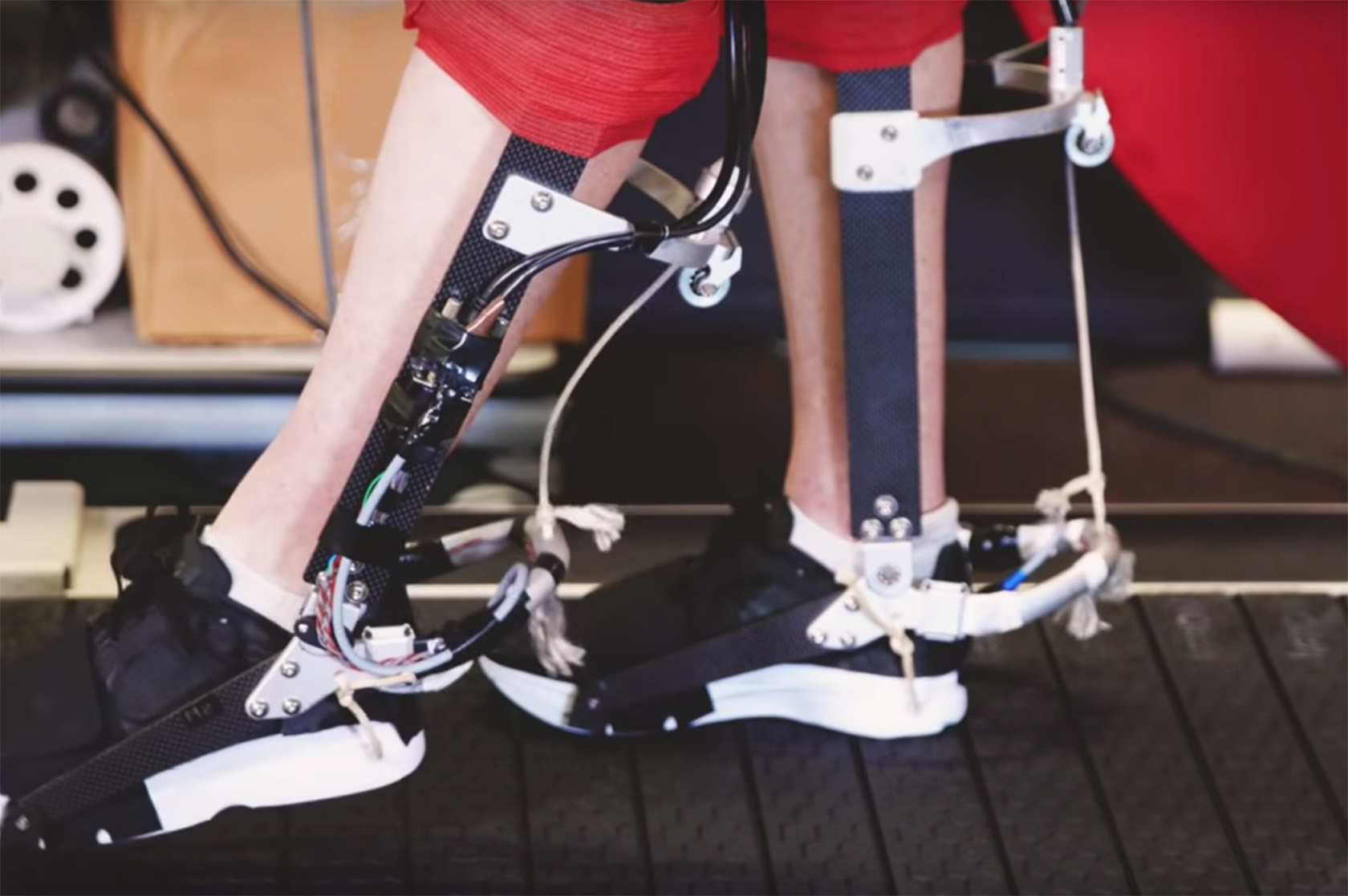

Running is great exercise, but not everyone’s body is up for the task. Engineers at Stanford University want to boost physical activity and possibly creating a new mode of transportation, so they are studying devices that people could strap to their legs to make running easier. What they came up with are exoskeleton emulators, which when powered by a motor, reduced the energy cost of running by 15 percent.
Users strap the ankle exoskeleton emulator’s frame around the shin and then attaches to the shoe with a rope looped under the heel, while a carbon fiber bar is inserted into the sole, near the toe. Motors situated behind the treadmill are used to generate the two modes of assistance. However, a spring-based exoskeleton would not use motors in the final product. When in spring-like mode, the exokskeleton mimics the influence of a spring running parallel to the calf, storing energy during the beginning of the step and unloading that energy as the toes push off.
No products found.
Powered assistance took off a lot of the energy burden of the calf muscles. It was very springy and very bouncy compared to normal running. Speaking from experience, that feels really good. When the device is providing that assistance, you feel like you could run forever,” said Delaney Miller, a graduate student at Stanford who is working on these exoskeletons and also helping test the devices.


